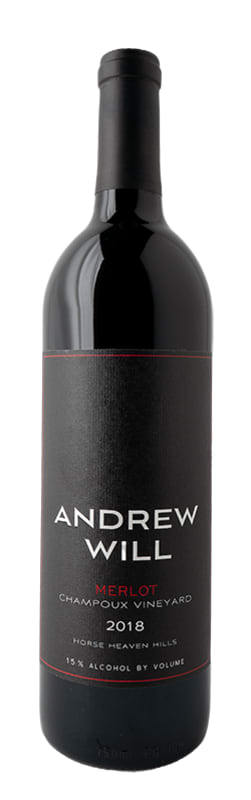


Winemaker Notes
A combination of dark fruit intermingles with notes of cassis, mocha and wildflowers. This wine has a rich and smooth mouthfeel that exhibits fine-grained tannins while still maintaining a sense of lift and freshness.
Professional Ratings
-
Robert Parker's Wine Advocate
Impeccably balanced, the 2018 Merlot Champoux Vineyard offers fresh and ripe fruit flavors of plum, black cherry and dusty purple flowers with hints of brown baking spices. Medium to full-bodied on the palate, the wine displays elevated alcohol with expertly managed tannins before showing a dusty mineral tension across the mid-palate. The Merlot concludes with a food-friendly and lingering finish. Just under 3,000 bottles were made for the world after the wine rested for 22 months in 25% new French oak. Bravo!
-
Jeb Dunnuck
Based on 100% Merlot from a great site in the Horse Heaven Hills, the 2018 Merlot Champoux Vineyard offers a smoky, meaty nose of black cherries, plums, chocolate, tobacco, and earth. This carries to a plum, mouth-filling, delicious Merlot with light tannins, a juicy, bright, elegant texture, and a good finish, all while packing plenty of ripe, opulent fruit.


With generous fruit and supple tannins, Merlot is made in a range of styles from everyday-drinking to world-renowned and age-worthy. Merlot is the dominant variety in the wines from Bordeaux’s Right Bank regions of St. Emilion and Pomerol, where it is often blended with Cabernet Franc to spectacular result. Merlot also frequently shines on its own, particularly in California’s Napa Valley. Somm Secret—As much as Miles derided the variety in the 2004 film, Sideways, his prized 1961 Château Cheval Blanc is actually a blend of Merlot and Cabernet Franc.

"Surely this is Horse Heaven!”
Its wide prairies and rolling expanses led an early pioneer to proclaim that the region looked like “horse heaven,” and as a result, the area was appropriately named. Horse Heaven Hills is in south central Washington state, geographically bound on its northern border by the Yakima River and in the south, by the larger Columbia River.
Its proximity to the Columbia River contributes to a variety of climactic factors that dramatically affect its grapes. In particular, an increase in wind from changes in pressure along the river, which flows from the cool and wet Pacific Ocean, inland to Washington’s hot and arid plains, creates 30% more wind than there would be otherwise. These winds moderate temperatures, protect against mold and rot, reduce the risk of early and late season frosts, diminish canopy size and toughen grape skins.
The vineyards bordering the river are on steep, south-facing, well-exposed slopes, with well-drained, sandy-loam soils. But the soils of the appellation are diverse throughout, ranging from wind-blown sand and loess, Missoula Flood sediment, and rocky basalt. Horse Heaven Hills has an arid continental climate with elevations ranging from 200 to 1,800 feet.
The first vines of the appellation were planted in 1972 in an optimal spot now referred to as the Champoux Vineyard. Today it remains the source of some of Washington’s most desirable and expensive Cabernet Sauvignons. In fact, the appellation as a whole boasts many of Washington’s top scoring wines. Its primary grape varieties are Cabernet Sauvignon, Merlot, Syrah, Chardonnay and Riesling.