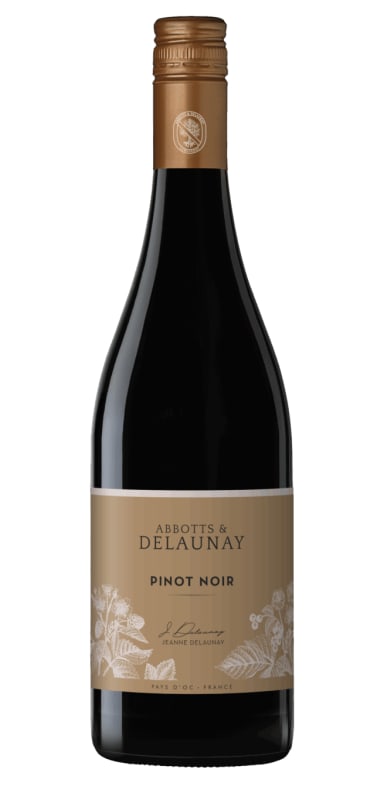


Winemaker Notes
Dark color, with ruby tints. This Pinot Noir has scents of red and black berries mixed with floral notes, hints of delicate wood and vanilla. The palate is complex, rich, long with aromas of blackberry, blackcurrant, cherry and jam.
Serve with charcuterie, white meat and mild cheeses.
Vegan-Friendly


Founded in 1996 in the small village of Marseillette, east of Carcassonne, Abbotts & Delaunay began as the vision of Nerida Abbott. In 2005, Laurent Delaunay acquired the estate, bringing with him five generations of Burgundian négociant heritage. A long-time advocate for the Languedoc’s potential, Laurent has led several notable projects across the region. The vineyards benefit from a unique landscape stretching from the Pyrenees to the Mediterranean, with diverse soils—sandstone, marl, limestone, and schist—that contribute to the wines’ distinctive character and strong sense of place.
Today, winemaking is led by Laurent’s daughter, Jeanne Delaunay, whose experience includes Domaine de la Romanée-Conti, Thibault Liger-Belair, and Coldstream Hills in Australia. Under her direction, the winery focuses on estate-grown fruit while partnering with growers throughout the region, always emphasizing terroir. Guided by a Burgundian philosophy, Jeanne prioritizes balance, elegance, and purity, ensuring that winemaking enhances rather than masks the natural expression of the land.

Pinot Noir is grown in many French regions but the greatest concentration is in the Champagne region. Here it is a key component, along with Chardonnay and Pinot Meunier, in the region’s famous sparkling wines, simply called, Champagne. On the eastern border with Germany, in Alsace, winemakers utilize it for both still and Sparkling Wines. In the Loire Valley it is used for red and rosé wines, namely in Sancerre. The Jura and Savoie also produce Pinot Noir, and small amounts are grown in higher altitude sections of southern France.
But the pinnacle of French Pinot Noir is unquestionably Burgundy, called Bourgogne locally. All top Burgundy reds are 100% Pinot Noir, with the finest—the Grand Crus—considered among the world’s most prestigious wines. The first recorded mentions of Pinot Noir in Burgundy date to the 14th century, though viticulture has been in the region for well over 2,000 years. For centuries Bourgogne was controlled by monastic orders that not only worked the vineyards but took meticulous notes about the wines that resulted from individual parcels. This detailed record-keeping led to the recognition that wines vary depending on the source of the grapes—even if made by the same person in the same way—and that certain sites consistently tend to produce superior wines.
These observations ultimately led to the designation of 33 Grands Crus (and over 600 Premiers Crus) vineyards. Most of these are in the small sloping area known as the Cote de Nuits, widely thought to be the ancestral and spiritual home of Pinot Noir. Bourgogne could also be said to epitomize the French concept of terroir—the combined sum of all-natural factors that affect a specific vineyard or parcel (called a climat). The notion of terroir lends itself perfectly to Pinot Noir, a thin-skinned grape that is highly reactive to its environment. When produced from exceptional sites, especially in fine vintages, the grape can lead to wines that are complex and sensual, with a subtlety and depth of flavor that make them both hedonistic and thought-provoking.