

Winemaker Notes
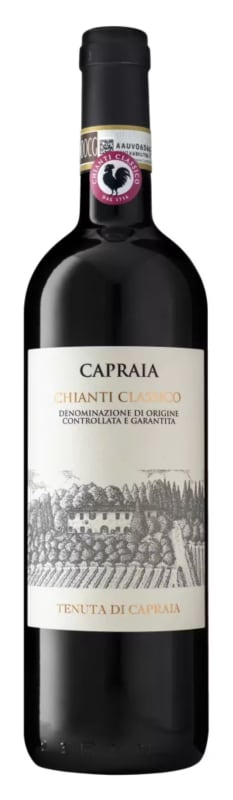
Tenuta di Capraia Chianti Classico presents excellent complexity and structure, displaying a vivid red color with violet reflections. The nose is intense and expressive, rich in fruity and vinous aromas, led by notes of ripe cherry and hints of fresh herbs. On the palate, the wine is well-balanced, with lively tannins perfectly integrated into its fruit-driven core. A fresh and persistent finish highlights its harmonious combination of elegance and depth.
Professional Ratings
-
James Suckling
Delicious, fruity and crunchy, this has aromas of red berries, baking spices and some cocoa. Medium-bodied with silky tannins. Juicy fruit with a succulent finish.
-
Wine Enthusiast
The nose has the texture of pencil shavings, coffee grinds and sage, and the tangy glint of bing cherries for energy. On the palate, strawberries and raspberries ride a wave of citrus and graphite, while lively acid washes over chalky tannins.
Best Buy -
Wine Spectator
This succulent red boasts blackberry, raspberry, violet and iron flavors, with accents of sweet spices. Harmonious and intense, pushing through the fruit- and spice-tinged finish. Sangiovese, Colorino and Canaiolo. Drink now through 2032.



The “Tenute Calì” wine group is the fruit of our family’s passion for agriculture, good wine and outstanding products. It is the result of our ambition to continuously improve quality through experience obtained from harvest to harvest.
In 1981, fascinated by its beauty and history, we bought one of the most ancient and noble Chianti Classico estates: Rocca di Castagnoli in Gaiole in Chianti. A farm that first belonged to the Tempi family, who enlarged it in 1730, then to Baron Ricasoli until the ‘50s. With this first acquisition, we began to implement our company mission: to create unique wines that are recognizable by their typical characteristics and respect for the surrounding area.
A few years later, in 2004, we decided to return to the place where our surname has its roots, Sicily, to one of the most artistic and suitable wine areas, thanks to its beautiful Baroque heritage and to the generosity of its land. The Graffetta estate is located between Noto and Modica, home to the Baroque style and Nero d’Avola. “We were born as farmers and vine growers who know the land and the local area. Love for the land and work in the vineyard has been part of our lives for generations. Experience, dedication over the years and hard work then taught us the art of wine-making.”
Proud of the work done so far, we decided to extend our presence in Tuscany and in 2005 we bought Poggio Maestrino in the Municipality of Magliano on the Maremma Coast, after falling in love with the beauty of the coast and the excellent quality of Morellino di Scansano. With this same passion we have continued the hard work of the wine-growers for almost forty years, captivated by the beauty and charm that only wine areas can boast.

Among Italy's elite red grape varieties, Sangiovese has the perfect intersection of bright red fruit and savory earthiness and is responsible for the best red wines of Tuscany. While it is best known as the chief component of Chianti, it is also the main grape in Vino Nobile di Montepulciano and reaches the height of its power and intensity in the complex, long-lived Brunello di Montalcino. Somm Secret—Sangiovese doubles under the alias, Nielluccio, on the French island of Corsica where it produces distinctly floral and refreshing reds and rosés.

One of the first wine regions anywhere to be officially recognized and delimited, Chianti Classico is today what was originally defined simply as Chianti. Already identified by the early 18th century as a superior zone, the official name of Chianti was proclaimed upon the area surrounding the townships of Castellina, Radda and Gaiole, just north of Siena, by Cosimo III, Grand Duke of Tuscany in an official decree in 1716.
However, by the 1930s the Italian government had appended this historic zone with additonal land in order to capitalize on the Chianti name. It wasn’t until 1996 that Chianti Classico became autonomous once again when the government granted a separate DOCG (Denominazione di Origine Controllata e Garantita) to its borders. Ever since, Chianti Classico considers itself no longer a subzone of Chianti.
Many Classicos are today made of 100% Sangiovese but can include up to 20% of other approved varieties grown within the Classico borders. The best Classicos will have a bright acidity, supple tannins and be full-bodied with plenty of ripe fruit (plums, black cherry, blackberry). Also common among the best Classicos are expressive notes of cedar, dried herbs, fennel, balsamic or tobacco.