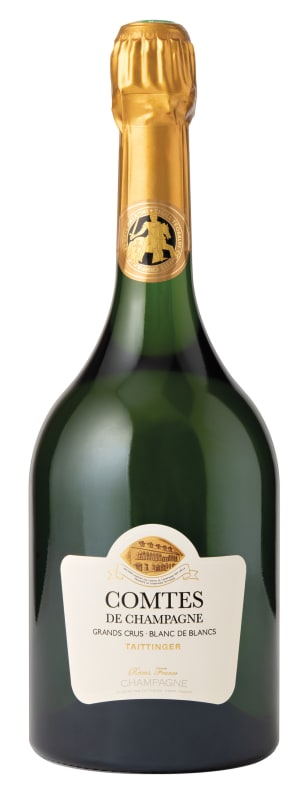


Winemaker Notes
Aromas of toasted brioche and pastries flavored with lemon meringue, hazelnut and almond. On the palate, the bubbles leave a gentle caress with a hint of zest and passion. This Comtes de Champagne 2014 offers a superb, mouthwatering freshness, an excellent structure and a long finish.
Professional Ratings
-
James Suckling
Wonderful aromas of cooked apples, bread dough, meringue, honeysuckle, lilacs and some lavender. Medium-bodied with density and focus, a tight palate and a lovely texture. Creamy mouthfeel. Long and seamless finish. Pure chardonnay. Aged for five or six months on the lees in 228-liter barrels. Disgorged January 2025. 9 g/L dosage. Drink or hold.
-
Vinous
The 2014 Comtes de Champagne is pristine. In this tasting, it comes across as a mini-2008, similar in its linear personality, with just a touch more mid-palate creaminess. Readers will find a Comtes that plays in the realm of tension and energy. Citrus confit, white flowers, chalk, mint and chamomile are all finely sketched. Light tropical overtones grace the finish. What an absolute delight. The 2014 can be enjoyed now or cellared. Dosage is 9 grams per liter.
-
Decanter
Taittinger's Comtes de Champagne shines in 2014. It's a vintage that offered crisp yet open and beautifully defined wines from the grand cru Chardonnays of the Côte des Blancs. This is still primary and youthful, its zesty roasted grapefruit, sweet clementine and pineapple flavours meet juicy white peach and gentle ageing flavours of demerara sugar and toasted brioche. It's a little less intense and dynamic than 2013 but equally fine in its restrained, racy energy. With even a short time on cork the classic toasty Comtes richness will start to emerge.
-
Robert Parker's Wine Advocate
Occupying a stylistic middle ground between the incisiveness of the 2013 and the fleshier textures of the 2012, Taittinger’s 2014 Blanc de Blancs Comtes de Champagne—disgorged in July 2024 with a dosage of nine grams per liter—has turned out beautifully. It offers aromas of orange peel, peach, pear and brioche mingled with hazelnut and burnt buttered toast. On the palate, it is full-bodied, ample and textural, with a layered yet crisp core of fruit, considerable tension and a long, chalky finish. Harmonious and racy-fresh though it is, this is a marginally richer rendition than the 2013 tasted alongside it, yet both promise excellent longevity and will make for fascinating comparative tastings in the years to come.
-
Wine Spectator
A textbook blanc de blancs Champagne, with a rich waft of toasted hazelnut on the nose, plus a voluptuous range of poached apricot, quince paste, tangerine peel and brioche notes that expand on the finely detailed mousse. Focused by well-cut acidity, this is long and mouthwatering, with fragrant spice, mineral and floral accents on the finish. Drink now through 2040.
-
Jeb Dunnuck
The 2014 Champagne Blanc de Blancs Comtes de Champagne pours a bright medium yellow hue and is very pretty, with a graceful floral perfume as well as notes of brioche and lemon curd. Full-bodied but more linear, the mousse is pillow-like, powdery, and perfumed and is followed by a long finish. I love where this is now. It’s quite complete and pretty already, and it’s a great bottle to drink while waiting on the 2012 and 2013. It’s less obvious as a vintage at this stage, but I do see it improving and developing into a very finessed wine. Drink 2025-2050.
Rating: 95+


Representing the topmost expression of a Champagne house, a vintage Champagne is one made from the produce of a single, superior harvest year. Vintage Champagnes account for a mere 5% of total Champagne production and are produced about three times in a decade. Champagne is typically made as a blend of multiple years in order to preserve the house style; these will have non-vintage, or simply, NV on the label. The term, "vintage," as it applies to all wine, simply means a single harvest year.

Associated with luxury, celebration, and romance, the region, Champagne, is home to the world’s most prized sparkling wine. In order to bear the label, ‘Champagne’, a sparkling wine must originate from this northeastern region of France—called Champagne—and adhere to strict quality standards. Made up of the three towns Reims, Épernay, and Aÿ, it was here that the traditional method of sparkling wine production was both invented and perfected, birthing a winemaking technique as well as a flavor profile that is now emulated worldwide.
Well-drained, limestone and chalky soil defines much of the region, which lend a mineral component to its wines. Champagne’s cold, continental climate promotes ample acidity in its grapes but weather differences from year to year can create significant variation between vintages. While vintage Champagnes are produced in exceptional years, non-vintage cuvées are produced annually from a blend of several years in order to produce Champagnes that maintain a consistent house style.
With nearly negligible exceptions, . These can be blended together or bottled as individual varietal Champagnes, depending on the final style of wine desired. Chardonnay, the only white variety, contributes freshness, elegance, lively acidity and notes of citrus, orchard fruit and white flowers. Pinot Noir and its relative Pinot Meunier, provide the backbone to many blends, adding structure, body and supple red fruit flavors. Wines with a large proportion of Pinot Meunier will be ready to drink earlier, while Pinot Noir contributes to longevity. Whether it is white or rosé, most Champagne is made from a blend of red and white grapes—and uniquely, rosé is often produce by blending together red and white wine. A Champagne made exclusively from Chardonnay will be labeled as ‘blanc de blancs,’ while ones comprised of only red grapes are called ‘blanc de noirs.’