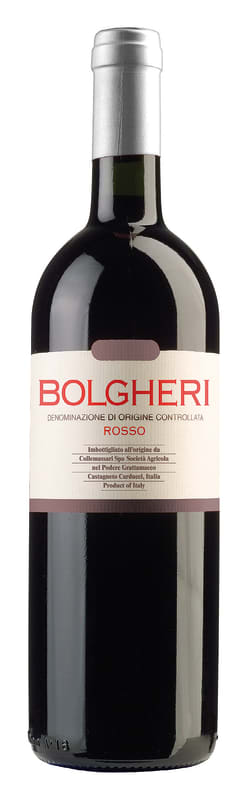


Winemaker Notes
The nose is a combo of dark fruits and chocolate with notes of plum and black currants, elegant and full with a fresh balsamic finish given by the Sangiovese.
Grattamacco's Bolgheri Rosso pairs perfectly with typical, hardy Tuscan dishes and is excellent throughout the meal for its freshness and its versatile character.
Blend: 30% Cabernet Sauvignon, 30% Merlot, 25% Cabernet Franc, 10% Sangiovese, 5% Petit Verdot
Professional Ratings
-
James Suckling
Quite rich, intense and spicy for a Bolgheri rosso, with embers, bark, licorice and ash. Supple and ripe, offering velvety tannins, medium body, crisp acidity and a round finish with savory, floral depth.
-
Jeb Dunnuck
A blend of 30% Cabernet Sauvignon, 30% Merlot, 25% Cabernet Franc, 10% Sangiovese, and the remainder Petit Verdot, the 2024 Bolgheri Rosso pours a youthful ruby/purple hue and is highly aromatic, with crushed wildflowers, black raspberry, cherry, orange, and refined herbal spice. Medium- to full-bodied, it’s elegant and light on its feet, with fine tannins, balanced acidity, and a linear, graceful profile with mineral undertones. It combines freshness with depth and finishes with excellent precision and length.


Disenchanted with Italian winemaking laws in the 1970s, a few rebellious Tuscan winemakers decided to get creative. Instead of following tradition, to bottle Sangiovese by itself, they started blending it with international varieties, namely Cabernet Sauvignon, Merlot and Syrah in differing proportions and with amazing success. However, some Tuscan Blends don’t even include Sangiovese. Somm Secret—The suffix –aia in Italian modifies a word in much the same way –y acts in English. For example, a place with many stones (sassi) becomes Sassicaia. While not all Super Tuscan producer names end in –aia, they all share a certain coy nomenclature.

An outstanding wine region made famous by Marchese Mario Incisa della Rocchetta, who planted Cabernet Sauvignon vines for his own consumption in 1940s on his San Guido estate, and called the resulting wine, Sassicaia. Today the region’s Tuscan reds are based on Cabernet Sauvignon and Merlot, which can be made as single varietal wines or blends. The local Sangiovese can make up no more than 50% of the blends. Today Sassicaia has its own DOC designation within the Bogheri DOC appellation.