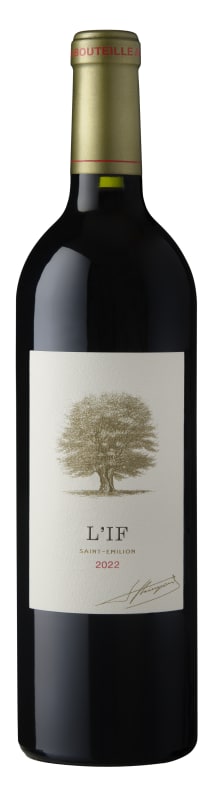


Winemaker Notes
Blend: 80% Merlot, 20% Cabernet Franc
Professional Ratings
-
James Suckling
A curious wine that offers lots of fruit character on the nose, beginning with blackberries and flowers that move to integrated tannins, proceeding to a firmness and a well-framed palate. 80% merlot and 20% cabernet franc. This needs four or five years but is lovely already.
-
Jeb Dunnuck
The 2022 Château L'If comes from eight hectares of vines, mostly located on the upper plates near Troplong Mondot. Based on 80% Merlot and 20% Cabernet Franc raised in 50% new oak, its deep ruby/purple hue is followed by a pure, incredibly elegant wine that has a core of black raspberry fruit as well as sappy flowers, chalky minerality, and hints of forest floor. Playing in the medium-bodied, silky, elegant end of the spectrum, it brings beautiful purity, ultra-fine tannins, and a great finish. The level of purity, finesse, and minerality here is something. Give bottles 3-5 years and enjoy over the following two decades.
-
Robert Parker's Wine Advocate
Aromas of sweet cherries, berries and plums mingled with hints of licorice and a discreet framing of toasty oak introduce the 2022 L'If, a medium to full-bodied, suave and polished wine that's lively, seamless and refined, concluding with a chalky, mineral finish. This is one of the best wines from this estate to date.
-
Wine Spectator
Shows enticing freshness, with boysenberry and blackberry confiture flavors and aromas laced with violet and iris hints and caressed by anise and black tea on the alluring finish. A subtle, chalky minerality deftly underpins the finish. Merlot and Cabernet Franc. Best from 2026 through 2036.
-
Vinous
The 2022 L'If feels a little overripe on the nose, touches of raisin and prune infusing the red berry fruit and strawberry cheesecake. The palate is medium-bodied with a bitter entry, quite tart, but it feels compressed and lacks flair towards the finish. I found this quite hard going compared to its peers and was surprised to find it was L'If. Tasted blind at the Southwold tasting in London.


One of the world’s most classic and popular styles of red wine, Bordeaux-inspired blends have spread from their homeland in France to nearly every corner of the New World. Typically based on either Cabernet Sauvignon or Merlot and supported by Cabernet Franc, Malbec and Petit Verdot, the best of these are densely hued, fragrant, full of fruit and boast a structure that begs for cellar time. Somm Secret—Blends from Bordeaux are generally earthier compared to those from the New World, which tend to be fruit-dominant.

Marked by its historic fortified village—perhaps the prettiest in all of Bordeaux, the St-Émilion appellation, along with its neighboring village of Pomerol, are leaders in quality on the Right Bank of Bordeaux. These Merlot-dominant red wines (complemented by various amounts of Cabernet Franc and/or Cabernet Sauvignon) remain some of the most admired and collected wines of the world.
St-Émilion has the longest history in wine production in Bordeaux—longer than the Left Bank—dating back to an 8th century monk named Saint Émilion who became a hermit in one of the many limestone caves scattered throughout the area.
Today St-Émilion is made up of hundreds of independent farmers dedicated to the same thing: growing Merlot and Cabernet Franc (and tiny amounts of Cabernet Sauvignon). While always roughly the same blend, the wines of St-Émilion vary considerably depending on the soil upon which they are grown—and the soils do vary considerably throughout the region.
The chateaux with the highest classification (Premier Grand Cru Classés) are on gravel-rich soils or steep, clay-limestone hillsides. There are only four given the highest rank, called Premier Grand Cru Classés A (Chateau Cheval Blanc, Ausone, Angélus, Pavie) and 14 are Premier Grand Cru Classés B. Much of the rest of the vineyards in the appellation are on flatter land where the soils are a mix of gravel, sand and alluvial matter.
Great wines from St-Émilion will be deep in color, and might have characteristics of blackberry liqueur, black raspberry, licorice, chocolate, grilled meat, earth or truffles. They will be bold, layered and lush.