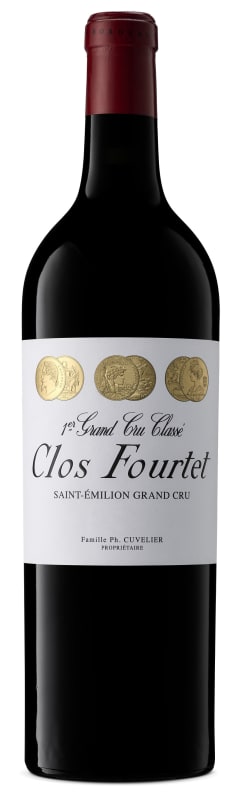


Winemaker Notes
Professional Ratings
-
Jeb Dunnuck
Deep ruby-hued and showing a dense, inward, powerful profile that may be due to a higher percentage of Cabernet Franc than normal, the 2025 Clos Fourtet offers ripe currants, black cherries, graphite, scorched earth, and chocolatey nuances that define the bouquet, and it's full-bodied on the palate, with deep, layered mid-palate richness, ripe tannins, and a great finish. Based on 84% Merlot, 10% Cabernet Franc, and 6% Cabernet Sauvignon from clay and limestone soils, it's going to need time, but it's certainly loaded with potential.
Barrel Sample: 96-98 -
Vinous
The 2025 Clos Fourtet is elegant, polished and super refined. Bracing mineral notes cut through a core of dark red and blue-toned fruit. Spice, mocha, new leather and licorice all meld together. Seamless and profoundly elegant, the 2025 impresses with its sensual personality, soft contours and magnificent balance. Time in the glass brings out touches of blood orange and white pepper that lend explosive brilliance through to the gorgeous, sustained finish. The team opted for cool fermentations in the cellar. Most lots saw 21-26 days on skins, which is on the shorter side. Clos Fourtet has recently shifted to doing malolactic fermentation in tank instead of in barrel, which has naturally lowered the wines' oak imprint, highlighted fruit purity and softened their contours. The 2025 is positively stellar. Tasted two times. Grand Vin. –Antonio Galloni
Barrel Sample: 96-98 -
Decanter
Ripe and heady blackcurrant aromas on the nose. Smells concentrated but fresh too. Supple and so juicy, really beautiful acidity giving tension but matched to ripe strawberries which give a gentle chew and a cooling blueberry touch with a chalky, flint and graphite finish. Friendly, balanced, smooth. There’s power but energy and elegance – this is beautiful, such a gorgeous texture. Great minerality with chalky tannins but nothing too much or out of place. A real wine of its place. A yield of 28hl/ha. 3.40pH. Malolactic fermentation in tank then ageing in just less than 40% new oak and the rest in one year old barrels 58% and 2% clay amphora.
Barrel Sample: 97 -
James Suckling
A deep and layered red with chocolate, berry, cherry, orange peel and some limestone aromas and flavors. Medium-bodied with lovely fruit and a tangy and vivid finish. Bright acidity comes out at the end.
Barrel Sample: 96-97 -
Robert Parker's Wine Advocate
Unfurling in the glass with notes of dark berries, plum and kirsch mingled with hints of iris and anise, the 2025 Clos Fourtet is full-bodied, ample and layered, with a multidimensional textural profile, tangy acids and a long and penetrating finish. To moderate extraction, fermentations were kept cool, at around 24 degrees Celsius, with only punching down. It's a blend of 84% Merlot, 10% Cabernet Franc and 6% Cabernet Sauvignon.
Barrel Sample: 94-96


One of the world’s most classic and popular styles of red wine, Bordeaux-inspired blends have spread from their homeland in France to nearly every corner of the New World. Typically based on either Cabernet Sauvignon or Merlot and supported by Cabernet Franc, Malbec and Petit Verdot, the best of these are densely hued, fragrant, full of fruit and boast a structure that begs for cellar time. Somm Secret—Blends from Bordeaux are generally earthier compared to those from the New World, which tend to be fruit-dominant.

Marked by its historic fortified village—perhaps the prettiest in all of Bordeaux, the St-Émilion appellation, along with its neighboring village of Pomerol, are leaders in quality on the Right Bank of Bordeaux. These Merlot-dominant red wines (complemented by various amounts of Cabernet Franc and/or Cabernet Sauvignon) remain some of the most admired and collected wines of the world.
St-Émilion has the longest history in wine production in Bordeaux—longer than the Left Bank—dating back to an 8th century monk named Saint Émilion who became a hermit in one of the many limestone caves scattered throughout the area.
Today St-Émilion is made up of hundreds of independent farmers dedicated to the same thing: growing Merlot and Cabernet Franc (and tiny amounts of Cabernet Sauvignon). While always roughly the same blend, the wines of St-Émilion vary considerably depending on the soil upon which they are grown—and the soils do vary considerably throughout the region.
The chateaux with the highest classification (Premier Grand Cru Classés) are on gravel-rich soils or steep, clay-limestone hillsides. There are only four given the highest rank, called Premier Grand Cru Classés A (Chateau Cheval Blanc, Ausone, Angélus, Pavie) and 14 are Premier Grand Cru Classés B. Much of the rest of the vineyards in the appellation are on flatter land where the soils are a mix of gravel, sand and alluvial matter.
Great wines from St-Émilion will be deep in color, and might have characteristics of blackberry liqueur, black raspberry, licorice, chocolate, grilled meat, earth or truffles. They will be bold, layered and lush.