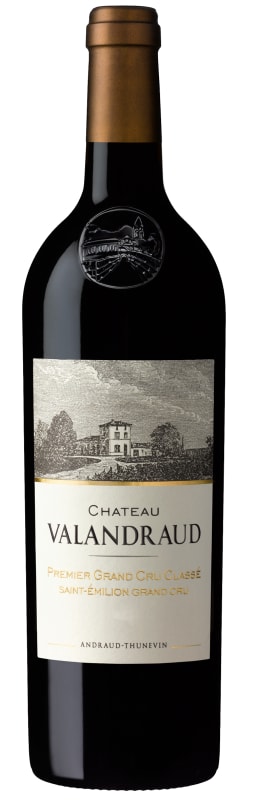


Winemaker Notes
Professional Ratings
-
Jeb Dunnuck
Based on 84% Merlot, 9% Cabernet Franc, and 7% Cabernet Sauvignon, the 2025 Château Valandraud is aging in 90% new French oak and has a dense purple hue as well as captivating aromatics of juicy red, blue, and black fruits, graphite, spring flowers, and an ultra-classic lead pencil character. Hitting 14% natural alcohol with a pH of 3.5, it’s concentrated and full-bodied on the palate, with incredible purity and a more restrained, elegant style than previous vintages. It has plenty of classic Valandraud greatness.
Barrel Sample: 97-99 -
Vinous
The 2025 Valandraud is breathtaking. Its the first vintage made by Jean-Luc Thunevin and Marie Lefévère together. It therefore represents a changing of the guard, now that Lefévère and her husband, Christophe, have taken full ownership of the property after many years holding a minority stake. Vibrant and explosive in the glass, the 2025 Valandraud offers an exotic mélange of dark blue/purplish fruit, lavender, spice and mocha. There's gorgeous precision here, much of that coming from more finesse in the tannins. The 2025 is utterly magnificent. Élevage is 90% new oak and 10% 15HL _foudres). Tasted two times. –Antonio Galloni
Barrel Sample: 96-99 -
James Suckling
Lots of dark fruit with an edge, supported by chalky tannins. Compact and concentrated, with a fresh medium body. The crunchy, chalky tannins help balance the wine’s exuberance. This shows an attractive combination of power, focused tannins, freshness and exuberant fruit, with hints of black mushrooms and ink. Aged for 20 months in 90% new oak and 10% foudres. 84% merlot, 9% cabernet sauvignon and 7% cabernet franc.
Barrel Sample: 96-97 -
Decanter
A new take on Valandraud this year after Jean-Luc Thunevin sold his majority stake to Christophe et Marie Lefévère (Château Sansonnet, Château Moulin du Cadet, Château Villemaurine. With Grégory Leymarie now managing director he said this is the perfect vintage to tell a new story with a new vision and a reduction in production by 20-25%. Gorgeous heady scents on the nose, ripe blackcurrant, cherries and strawberries. Chalky, velvety, ripe but not overly so, you have that intensity and concentration of fruit – but there’s such finesse. Elegance is here in spades, this is soft and approachable already. A juicy, clean and crystalline core with a soft salty, oyster shell mineral bite. I love this for its calmness, roundness and general softness. You still have the signature fruit aspect – the spiced aromatics and the clean blackcurrant, plum and black cherry fruit – the signature of the estate is still recognisable but with a lot more delicacy. Ageing 100% new oak. 3.48pH, 4g total acidity.
Barrel Sample: 96


One of the world’s most classic and popular styles of red wine, Bordeaux-inspired blends have spread from their homeland in France to nearly every corner of the New World. Typically based on either Cabernet Sauvignon or Merlot and supported by Cabernet Franc, Malbec and Petit Verdot, the best of these are densely hued, fragrant, full of fruit and boast a structure that begs for cellar time. Somm Secret—Blends from Bordeaux are generally earthier compared to those from the New World, which tend to be fruit-dominant.

Marked by its historic fortified village—perhaps the prettiest in all of Bordeaux, the St-Émilion appellation, along with its neighboring village of Pomerol, are leaders in quality on the Right Bank of Bordeaux. These Merlot-dominant red wines (complemented by various amounts of Cabernet Franc and/or Cabernet Sauvignon) remain some of the most admired and collected wines of the world.
St-Émilion has the longest history in wine production in Bordeaux—longer than the Left Bank—dating back to an 8th century monk named Saint Émilion who became a hermit in one of the many limestone caves scattered throughout the area.
Today St-Émilion is made up of hundreds of independent farmers dedicated to the same thing: growing Merlot and Cabernet Franc (and tiny amounts of Cabernet Sauvignon). While always roughly the same blend, the wines of St-Émilion vary considerably depending on the soil upon which they are grown—and the soils do vary considerably throughout the region.
The chateaux with the highest classification (Premier Grand Cru Classés) are on gravel-rich soils or steep, clay-limestone hillsides. There are only four given the highest rank, called Premier Grand Cru Classés A (Chateau Cheval Blanc, Ausone, Angélus, Pavie) and 14 are Premier Grand Cru Classés B. Much of the rest of the vineyards in the appellation are on flatter land where the soils are a mix of gravel, sand and alluvial matter.
Great wines from St-Émilion will be deep in color, and might have characteristics of blackberry liqueur, black raspberry, licorice, chocolate, grilled meat, earth or truffles. They will be bold, layered and lush.