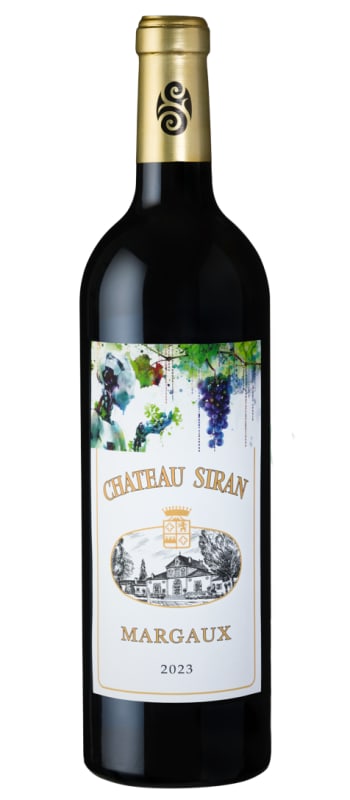


Winemaker Notes
Blend: 49% Merlot, 41% Cabernet Sauvignon, and 10% Petit Verdot
Professional Ratings
-
Jeb Dunnuck
A brilliant Siran, the 2023 Château Siran offers ripe, perfumed, incredibly complex aromatics of red and black fruits, spicy herbs/flowers, tobacco, and cedar pencil. Based on 49% Merlot, 41% Cabernet Sauvignon, and 10% Petit Verdot and aged 12 months in 35% new French oak, it has that classic Margaux spice, complexity, and elegance. Medium-bodied on the palate, it has a pure, layered mouthfeel, beautiful overall balance, and a gorgeous finish. It offers immense pleasure today yet should have 25+ years of overall longevity. This is well worth seeking out and stocking up on, and it might be the finest Siran to date.
-
Vinous
The 2023 Siran, picked September 11 to 29, has a well-defined bouquet that is not as complex as the previous vintage. It is focused and delineated, with black fruit mixed with graphite and melted tar, almost Saint-Julien in style. The palate is medium-bodied with pliant tannins, quite minerally and lively without the depth of the 2022, yet rather elegant and refined on the finish. This constitutes a very gracious Margaux and as I tried second and third bottles towards the end of my trip, it just seemed to get better and better. –Neal Martin
Barrel Sample: 92-94 -
Wine Enthusiast
This sophis- ticated wine, with its ripe tannins and beauti- fully balanced texture, is rich and structured. With its spice aroma and fine layers of black-currant fruits, the wine will develop at a stately pace
-
James Suckling
An approachable Margaux with good fruit expression, showing berries, cassis, plums and elegant spices. A touch of cured meat as well. Medium-bodied with fine-grained tannins and a long, pretty cohesive finish. A blend of 49% merlot, 41% cabernet sauvignon and 10% petit verdot.
-
Decanter
Ripe blackberry and cassis aromas with tar introduce a palate of both brambly red and juicy plum, with deft, if slightly tart, tannin. Tasted twice, one sample showed steelier tannin than the other, but both exhibited a more linear rather than broad texture and approach to the medium finish. While I like the precision, there was something a bit more homespun about this fine wine, when compared to some of its Margaux peers, but barrel ageing should lend more palate depth.
Barrel Sample: 92 -
Wine Spectator
A deliciously inviting style, with a soft-edged core of plum and black cherry compote that rolls along steadily over the underlying juiciness, while flashes of ink, chestnut leaf and violet fill in. Silky in structure and fresh through the finish. Merlot, Cabernet Sauvignon and Petit Verdot.
-
Wilfred Wong of Wine.com
The 2023 Château Siran is a charming, quietly expressive Margaux, offering beautifully detailed flavors of fresh strawberries and ripe cherries. Understated and graceful rather than showy, it glides across the palate with finesse and poise. Its delicacy and balance make it an ideal partner for subtly seasoned Vietnamese pork dishes, where nuance matters more than weight. (Tasted: January 22, 2026, San Francisco, CA)


One of the world’s most classic and popular styles of red wine, Bordeaux-inspired blends have spread from their homeland in France to nearly every corner of the New World. Typically based on either Cabernet Sauvignon or Merlot and supported by Cabernet Franc, Malbec and Petit Verdot, the best of these are densely hued, fragrant, full of fruit and boast a structure that begs for cellar time. Somm Secret—Blends from Bordeaux are generally earthier compared to those from the New World, which tend to be fruit-dominant.

Silky, seductive and polished are the words that characterize the best wines from Margaux, the most inland appellation of the Médoc on the Left Bank of Bordeaux.
Margaux’s gravel soils are the thinnest of the Médoc, making them most penetrable by vine roots—some reaching down over 23 feet for water. The best sites are said to be on gentle outcrops, or croupes, where more gravel facilitates good drainage.
The Left Bank of Bordeaux subscribes to an arguably outdated method of classification but it is nonetheless important in regards to history of the area. In 1855 the finest chateaux were deemed on the basis of reputation and trading price—at that time. In 1855, Chateau Margaux achieved first growth status, yet it has been Chateau Palmer (officially third growth from the 1855 classification) that has consistently outperformed others throughout the 20th century.
Chateau Margaux in top vintages is capable of producing red Cabernet Sauvignon based wines described as pure, intense, spell-binding, refined and profound with flavors and aromas of black currant, violets, roses, orange peel, black tea and incense.
Other top producers worthy of noting include Chateau Rauzan-Ségla, Lascombes, Brane-Cantenac, and d’Issan, among others.
The best wines of Margaux combine a deep ruby color with a polished structure, concentration and an unrivaled elegance.