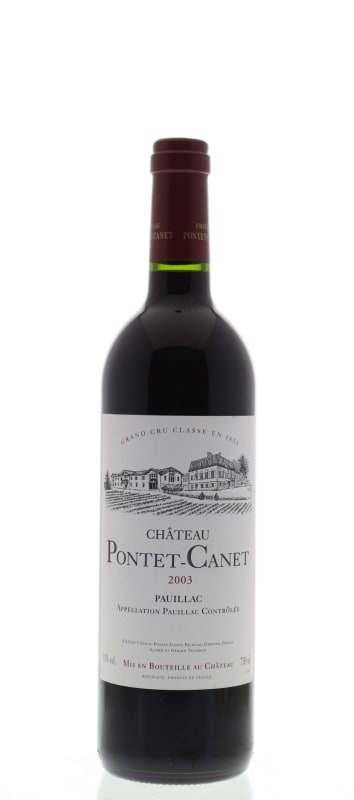


Winemaker Notes
Professional Ratings
-
Robert Parker's Wine Advocate
The spectacular 2003 Pontet Canet is still incredibly young and vigorous. This full-bodied classic boasts a dense purple color as well as a superb nose of graphite, creme de cassis, forest floor, licorice and a hint of truffles, low acidity, and extravagant richness. Most of the tannins have been resolved in this superstar of the vintage. It should continue to drink well for 10-15+ years. 95+
-
Wine Spectator
Gorgeous raspberry, licorice and currant with hints of toasted oak. Full-bodied, with silky tannins and lots of currant and berry character. Refined. Long, long finish. Best after 2010.
-
James Suckling
Pure ripe fruit on the nose with raspberries and blueberries. Full bodied, with round and silky tannins and a pretty polish to this ripe and fruit forward wine. Pull the cork after 2014.
-
Wine Enthusiast
A closed, austere wine; more solid than fruity, showing very firm tannins. There is a pronounced smoky character as well, with cigar box aromas and toasty flavors. What is certain is that this wine—racy and not too heavy—will develop slowly. Imported by Diageo Chateau & Estates.


One of the world’s most classic and popular styles of red wine, Bordeaux-inspired blends have spread from their homeland in France to nearly every corner of the New World. Typically based on either Cabernet Sauvignon or Merlot and supported by Cabernet Franc, Malbec and Petit Verdot, the best of these are densely hued, fragrant, full of fruit and boast a structure that begs for cellar time. Somm Secret—Blends from Bordeaux are generally earthier compared to those from the New World, which tend to be fruit-dominant.

The leader on the Left Bank in number of first growth classified producers within its boundaries, Pauillac has more than any of the other appellations, at three of the five. Chateau Lafite Rothschild and Mouton Rothschild border St. Estephe on its northern end and Chateau Latour is at Pauillac’s southern end, bordering St. Julien.
While the first growths are certainly some of the better producers of the Left Bank, today they often compete with some of the “lower ranked” producers (second, third, fourth, fifth growth) in quality and value. The Left Bank of Bordeaux subscribes to an arguably outdated method of classification that goes back to 1855. The finest chateaux in that year were judged on the basis of reputation and trading price; changes in rank since then have been miniscule at best. Today producers such as Chateau Pontet-Canet, Chateau Grand Puy-Lacoste, Chateau Lynch-Bages, among others (all fifth growth) offer some of the most outstanding wines in all of Bordeaux.
Defining characteristics of fine wines from Pauillac (i.e. Cabernet-based Bordeaux Blends) include inky and juicy blackcurrant, cedar or cigar box and plush or chalky tannins.
Layers of gravel in the Pauillac region are key to its wines’ character and quality. The layers offer excellent drainage in the relatively flat topography of the region allowing water to run off into “jalles” or streams, which subsequently flow off into the Gironde.