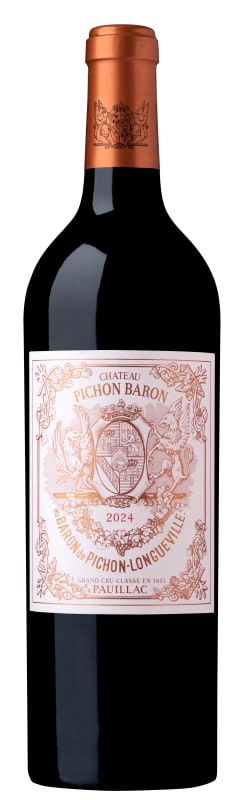


Winemaker Notes
This authentic Pauillac offers an amazing sensory experience with its black fruit flavors and spicy hints. Château Pichon Baron shows great elegance, intensity and exceptional length on the palate. It is a wine that improves year after year and can age for over 40 years in the cellar.
Blend: 87% Cabernet Sauvignon, 13% Merlot
This wine does not include the blanket 10% tariff imposed in April 2025. When the wines are shippable in fall of 2027, customers will have the option to pay any tariff in place at the time or to keep their wines stored in a temperature-controlled facility free of charge in France.
Professional Ratings
-
Decanter
One of my favourites. Cranberry, bramble fruit, vanilla cream and cool blueberries. Supple and totally charming from the first sip - rich and concentrated fruit no doubt, ripeness is there but this is slick and well framed. Keeps focus all the way through but the tannins are well defined, firm and supportive with cool, freshness and a lovely texture to the fruit. Graceful but definitely with a hint of richness which is just great. Totally elegant. There’s spaidity and unctuosity. So much flavour - this isn't a light wine but it dances across the palate with power and length. This will be finished in an instant. Ageing 70% in new barrels and 30% from barrels of one vintage for 18 months.
Barrel Sample: 96 -
Jeb Dunnuck
Beautiful stuff, the 2024 Château Pichon-Longueville Baron has ripe currant and cassis fruit intermixed with classic lead pencil, graphite, and tobacco nuances. It's medium-bodied, with a pure, layered, and elegant mouthfeel, notable tannins, and outstanding length. The 2024 is based on 87% Cabernet Sauvignon and 13% Merlot, hitting 12.7% alcohol with a pH of 3.71.
Barrel Sample: 94-96 -
James Suckling
A dense wine with good richness and concentration. Slightly chewy, with an almost full body and a tight-grained finish. Long, structured and powerful. Not a lighter year for Pichon Baron, thanks to the low yield of just around 20 hectoliters per hectare. 87% cabernet sauvignon and 13% merlot.
Barrel Sample: 95-96 -
Robert Parker's Wine Advocate
The 2024 Pichon-Longueville Baron opens in the glass with aromas of cassis, blackberries, cigar wrappers and pencil shavings. Medium to full-bodied, lively and layered, with a dense core of fruit, tangy acids and powdery tannins, this blend of 87% Cabernet Sauvignon and 13% Merlot is a serious young Pauillac that will demand patience.
Barrel Sample: 90-93


One of the world’s most classic and popular styles of red wine, Bordeaux-inspired blends have spread from their homeland in France to nearly every corner of the New World. Typically based on either Cabernet Sauvignon or Merlot and supported by Cabernet Franc, Malbec and Petit Verdot, the best of these are densely hued, fragrant, full of fruit and boast a structure that begs for cellar time. Somm Secret—Blends from Bordeaux are generally earthier compared to those from the New World, which tend to be fruit-dominant.

The leader on the Left Bank in number of first growth classified producers within its boundaries, Pauillac has more than any of the other appellations, at three of the five. Chateau Lafite Rothschild and Mouton Rothschild border St. Estephe on its northern end and Chateau Latour is at Pauillac’s southern end, bordering St. Julien.
While the first growths are certainly some of the better producers of the Left Bank, today they often compete with some of the “lower ranked” producers (second, third, fourth, fifth growth) in quality and value. The Left Bank of Bordeaux subscribes to an arguably outdated method of classification that goes back to 1855. The finest chateaux in that year were judged on the basis of reputation and trading price; changes in rank since then have been miniscule at best. Today producers such as Chateau Pontet-Canet, Chateau Grand Puy-Lacoste, Chateau Lynch-Bages, among others (all fifth growth) offer some of the most outstanding wines in all of Bordeaux.
Defining characteristics of fine wines from Pauillac (i.e. Cabernet-based Bordeaux Blends) include inky and juicy blackcurrant, cedar or cigar box and plush or chalky tannins.
Layers of gravel in the Pauillac region are key to its wines’ character and quality. The layers offer excellent drainage in the relatively flat topography of the region allowing water to run off into “jalles” or streams, which subsequently flow off into the Gironde.