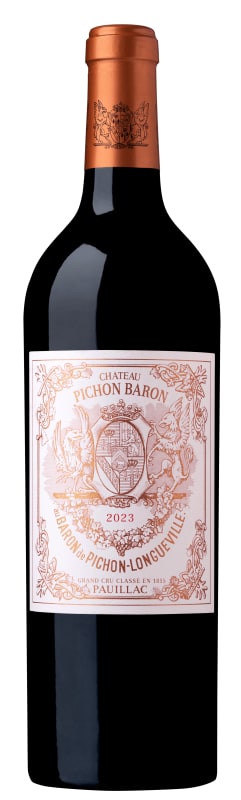


Winemaker Notes
Our Grand Vin Château Pichon Baron 2nd Grand Cru Classé in 1855 comes from the very oldest vines grown on the historic plots of the estate. This authentic Pauillac offers an amazing sensory experience with its black fruit flavours and spicy hints. Château Pichon Baron shows great elegance, intensity and exceptional length on the palate. It is a wine that improves year after year and can age for over 40 years in the cellar.
Blend: 80% Cabernet Sauvignon, 20% Merlot
Professional Ratings
-
James Suckling
A rich and rather flamboyant Baron with plenty of tannic structure and intensity. It's full-bodied and layered with plenty of ripe fruit, but then it tightens at the end, with flavors of black currants, bark, flowers, dark tobacco, graphite and citrus acidity. Lively at the end. 80% cabernet sauvignon and 20% merlot
-
Decanter
Perfumed nose, fragrant and so scented, a touch of blackcurrant leaf, plum, graphite and dark chocolate. Silky soft, bright and so delicately presented. Crunchy and crisp red fruits and ripe black fruits with some spiced undercurrents and wet stone touches. Much lighter in terms of fruit profile than some - summer berries, tangy and vibrant with super fine tannins giving the structure and support. This has finesse and power - less plushness and richness than last year of course - it’s more sleek and straight, firm and controlled but still has width and layers of flavour and texture. Refined, and definitely cool. ‘Classicism’ with no overt heat on offer. I love the hint of strawberry sweetness and tannins that completely coat the mouth. I think this will be great in time. Maybe not so charming right now but there’s no faulting the finesse and refinement. 44% grand vin production. 12% press. 3.7pH.
Barrel Sample: 97 -
Jeb Dunnuck
A blend of 80% Cabernet Sauvignon and 20% Merlot aged 18 months in 70% new French oak, the 2023 Château Pichon-Longueville Baron is another classic wine from this impeccably run estate, which I suspect is making some of its greatest wines today. Ripe currants, spicy wood, graphite, and tobacco all emerge on the nose, and it’s medium to full-bodied, with a pure, graceful mouthfeel, plenty of tannins, and outstanding length. Reminding me of the 2008, and perhaps even the 2019, it’s a very classy, aristocratic style of Pichon Baron that stands out for its balance and length. Give bottles 4-5 years and enjoy them over the following 25+ years. Drink 2030-2060.
-
Robert Parker's Wine Advocate
The 2023 Pichon-Longueville Baron has turned out impressively, revealing aromas of cassis, pencil shavings, violet, spices and smoldering embers, with new oak all but invisible. Medium- to full-bodied, deep and layered, it is beautifully balanced, built around a fleshy core of fruit and a concentrated mid-palate, framed by powdery tannins and concluding with a long, mineral and resonant finish. It achieves a rare synthesis of classical identity and seductive charm.
-
Vinous
The 2023 Pichon Baron is stellar. It is another wine in this lineup that impresses with its finesse and nobility. Dark and enveloping, with terrific freshness, this Grand Vin is so expressive. The 2023 is an understated, wonderfully refined Pichon Baron. Dark fruit, violet and mocha build into the resonant finish. –Antonio Galloni
Barrel Sample: 95-97 -
Wilfred Wong of Wine.com
Château Pichon Baron has been my quintessential Pauillac for decades. The 2023 vintage once again proves larger than life—firm, sturdy, and deeply satisfying. Layers of black fruits, graphite, and impeccably judged oak unfold within a perfectly balanced framework of power and precision. Serve this unapologetically with a tomahawk ribeye, carved tableside if possible, and finished with a bold swipe of fresh horseradish. (Tasted: January 22, 2026, San Francisco, CA)
-
Wine Enthusiast
The wine’s classic velvet Cabernet Sauvignon character is underlined by rich tannins and layers of beautiful black-currant fruit. Dark-chocolate aromas and great concentration are impressive.
-
Wine Spectator
This is a step ahead, as its flavors of cassis, blackberry and black cherry preserves show lushness that belies the vintage character. Underneath run graphite girders for support, along with ink, black licorice and roasted apple wood notes. The finish sports intensity and drive, providing a frank counterpoint to the lush fruit while knitting everything together. A heck of an effort for the vintage. Cabernet Sauvignon and Merlot.


One of the world’s most classic and popular styles of red wine, Bordeaux-inspired blends have spread from their homeland in France to nearly every corner of the New World. Typically based on either Cabernet Sauvignon or Merlot and supported by Cabernet Franc, Malbec and Petit Verdot, the best of these are densely hued, fragrant, full of fruit and boast a structure that begs for cellar time. Somm Secret—Blends from Bordeaux are generally earthier compared to those from the New World, which tend to be fruit-dominant.

The leader on the Left Bank in number of first growth classified producers within its boundaries, Pauillac has more than any of the other appellations, at three of the five. Chateau Lafite Rothschild and Mouton Rothschild border St. Estephe on its northern end and Chateau Latour is at Pauillac’s southern end, bordering St. Julien.
While the first growths are certainly some of the better producers of the Left Bank, today they often compete with some of the “lower ranked” producers (second, third, fourth, fifth growth) in quality and value. The Left Bank of Bordeaux subscribes to an arguably outdated method of classification that goes back to 1855. The finest chateaux in that year were judged on the basis of reputation and trading price; changes in rank since then have been miniscule at best. Today producers such as Chateau Pontet-Canet, Chateau Grand Puy-Lacoste, Chateau Lynch-Bages, among others (all fifth growth) offer some of the most outstanding wines in all of Bordeaux.
Defining characteristics of fine wines from Pauillac (i.e. Cabernet-based Bordeaux Blends) include inky and juicy blackcurrant, cedar or cigar box and plush or chalky tannins.
Layers of gravel in the Pauillac region are key to its wines’ character and quality. The layers offer excellent drainage in the relatively flat topography of the region allowing water to run off into “jalles” or streams, which subsequently flow off into the Gironde.