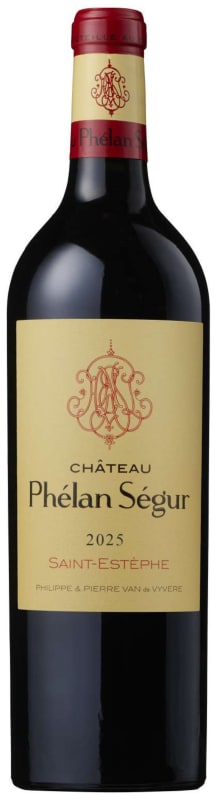


Winemaker Notes
2025 is a vintage of precision, where each stage unfolded with great consistency. The weather conditions produced concentrated grapes, but their primary goal was to preserve the fruit's balance and harmony. The Cabernet Sauvignon grapes express themselves with great clarity, bringing freshness and structure. The wine stands out for its purity, the finesse of its tannins, its freshness, and its balance. It clearly embodies the signature of Phélan Ségur, in its most faithful and authentic form.
Blend: 65% Cabernet Sauvignon, 30% Merlot, 3% Cabernet Franc, 2% Petit Verdot
Professional Ratings
-
James Suckling
Well composed, structured and nicely framed, with a medium to full body and fine, firm tannins. Textural and slightly chalky on the palate. Solid and focused, with a long, driven finish. A elegant, refine and holistic wine. The shows depth structre and finesse. 65% cabernet sauvignon, 30% merlot, 3% cabernet franc, and 2% petit verot.
Barrel Sample: 96-97 -
Decanter
Incredible colour in the glass – vivid purple core with a bright pink rim. Smells inviting – creamy strawberry, freshly cut herbs and pink roses. Smooth and supple, excellent construction in the round and filling tannins with a gorgeous chewy aspect to them. Mouthwatering but also slightly sweet strawberry flavours make this so fruity and charming. Soft, sophisticated, refined but really welcoming. Powdery tannins with ripe fruit. This is such assured winemaking with precision and focus. Refined. Succulent, totally moreish. Not massively shouting, despite the texture it retains a cool aspect with a stony grip on the bottom. Lovely. A complete package. One of the best I’ve tasted from this estate. Yield of 29hl/ha. 3.73pH. 80IPT. 65% grand vin production. The first time the estate harvested more than 10ha in one day with the harvest last for eight days between 10-26 September. 2% Petit Verdot completes the blend.
Barrel Sample: 96 -
Jeb Dunnuck
A gorgeous effort from this team, the 2025 Château Phélan Ségur is based on 65% Cabernet Sauvignon, 30% Merlot, 3% Cabernet Franc, and 2% Petit Verdot that's being raised 18 months in 55% new barrels. Cassis, spring flowers, graphite, and spicy nuances all shine on the nose, and it's medium to full-bodied on the palate, with gorgeous tannins and a velvety, perfectly balanced mouthfeel. I love the overall balance here, and it checks in at 13.6% alcohol with a pH of 3.73. This is up there with the finest vintages from this château to date. Bravo.
Barrel Sample: 94-96 -
Vinous
The 2025 Phélan Ségur was picked between September 10 and 26 at 29 hl/ha, matured in 55% new oak barrels. Again, this is a Saint-Estèphe that is cut in a more mellow and classical style compared to the 2020 or 2022, for example. Mainly black fruit, the Cabernet-dominated scents of cedar and tobacco emerge within a couple of swirls, with just a light touch of tea leaves in the background. The palate is medium-bodied, with fine-boned tannins matched by a silver thread of acidity. Very well balanced and unequivocally in the more elegant style, without the concentration or voluptuousness of the 2022. This is more sleek and refined, ergo, an earlier-drinking Phélan Ségur that delivers elegance and refinement. Just a lovely Saint-Estèphe that was presumed vanquished by global warming. –Neal Martin
Barrel Sample: 93-95


One of the world’s most classic and popular styles of red wine, Bordeaux-inspired blends have spread from their homeland in France to nearly every corner of the New World. Typically based on either Cabernet Sauvignon or Merlot and supported by Cabernet Franc, Malbec and Petit Verdot, the best of these are densely hued, fragrant, full of fruit and boast a structure that begs for cellar time. Somm Secret—Blends from Bordeaux are generally earthier compared to those from the New World, which tend to be fruit-dominant.

Deeply colored, concentrated, and distinctive, St. Estephe is the go-to for great, age-worthy and reliable Bordeaux reds. Separated from Pauillac merely by a stream, St. Estephe is the farthest northwest of the highest classed villages of the Haut Medoc and is therefore subject to the most intense maritime influence of the Atlantic.
St. Estephe soils are rich in gravel like all of the best sites of the Haut Medoc but here the formation of gravel over clay creates a cooler atmosphere for its vines compared to those in the villages farther downstream. This results in delayed ripening and wines with higher acidity compared to the other villages.
While they can seem a bit austere when young, St. Estephe reds prove to live very long in the cellar. Traitionally dominated by Cabernet Sauvignon, many producers now add a significant proportion of Merlot to the blend, which will soften any sharp edges of the more tannic, Cabernet.
The St. Estephe village contains two second growths, Chateau Montrose and Cos d’Estournel.