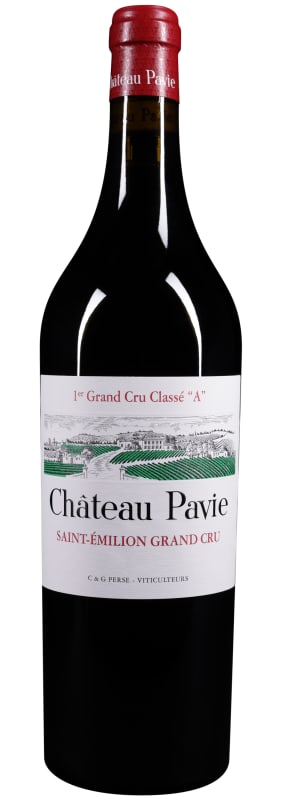


Winemaker Notes
Blend: 51% Merlot, 32% Cabernet Franc, 17% Cabernet Sauvignon
Professional Ratings
-
Jeb Dunnuck
Ripe black fruits, graphite, crushed stone, chocolate, and some truffly earth nuances all define the 2023 Château Pavie, a gorgeous wine that's certainly up with the crème de la crème of the vintage. Based on 65% Merlot, 20% Cabernet Franc, and 15% Cabernet Sauvignon and aged 20 months in 72% new French oak, it's medium to full-bodied, with a concentrated, layered mouthfeel and a great finish. The purity, balance, and elegance here are absolutely brilliant. Hide bottles for 4-5 years if you can, and it will shine for three decades. Drink 2030-2060.
-
Decanter
Aromatic nose, clean and clear, lovely pristine black and red fruits, some dark chocolate with violets, graphite and liquorice. Gorgeous succulence, this is so clear and crystalline with some juicy strawberry and bitter orange. A touch of tension gives the backbone and structure - great direction and movement from start to finish. Poised and piercing - so direct - I love the finesse and refinement, everything feels so elegant. Layered and complex but with zing, a sense of life and tons of energy. Still compact, no doubt, as you'd expect but tannins are fine and the wine has been well constructed - this will be delicious. An impressive showing for Pavie in 2023. 3.66pH.
Barrel Sample: 97 -
Vinous
The 2023 Pavie is fabulous. Rich, dense and explosive in the glass, it offers up generous dark red fruit, cedar, spice, pipe tobacco, menthol and mocha. The 2023 impresses with its notable density and sheer palate presence. Naturally, this needs time to be at its best, but it is already incredibly expressive. This is a superb vintage for Pavie. –Antonio Galloni
Barrel Sample: 95-97+ -
James Suckling
A bold wine. Perfumed aromas of violets, sandalwood, blackberries, blueberries and graphite. Full-bodied but not overpowering, with lots of fruit, juicy tannins and a powerful finish. Chewy. 51% merlot, 32% cabernet franc and 17% cabernet sauvignon.
-
Wine Spectator
Plush, warm and inviting in style, this red offers a broad, caressing and steadily rolling wave of plum sauce and boysenberry reduction that combines seamlessly with black tea, cocoa and roasted apple wood notes. There’s a licorice snap echo on the finish. For those that like a little bling with their wine. Merlot, Cabernet Franc and Cabernet Sauvignon.


One of the world’s most classic and popular styles of red wine, Bordeaux-inspired blends have spread from their homeland in France to nearly every corner of the New World. Typically based on either Cabernet Sauvignon or Merlot and supported by Cabernet Franc, Malbec and Petit Verdot, the best of these are densely hued, fragrant, full of fruit and boast a structure that begs for cellar time. Somm Secret—Blends from Bordeaux are generally earthier compared to those from the New World, which tend to be fruit-dominant.

Marked by its historic fortified village—perhaps the prettiest in all of Bordeaux, the St-Émilion appellation, along with its neighboring village of Pomerol, are leaders in quality on the Right Bank of Bordeaux. These Merlot-dominant red wines (complemented by various amounts of Cabernet Franc and/or Cabernet Sauvignon) remain some of the most admired and collected wines of the world.
St-Émilion has the longest history in wine production in Bordeaux—longer than the Left Bank—dating back to an 8th century monk named Saint Émilion who became a hermit in one of the many limestone caves scattered throughout the area.
Today St-Émilion is made up of hundreds of independent farmers dedicated to the same thing: growing Merlot and Cabernet Franc (and tiny amounts of Cabernet Sauvignon). While always roughly the same blend, the wines of St-Émilion vary considerably depending on the soil upon which they are grown—and the soils do vary considerably throughout the region.
The chateaux with the highest classification (Premier Grand Cru Classés) are on gravel-rich soils or steep, clay-limestone hillsides. There are only four given the highest rank, called Premier Grand Cru Classés A (Chateau Cheval Blanc, Ausone, Angélus, Pavie) and 14 are Premier Grand Cru Classés B. Much of the rest of the vineyards in the appellation are on flatter land where the soils are a mix of gravel, sand and alluvial matter.
Great wines from St-Émilion will be deep in color, and might have characteristics of blackberry liqueur, black raspberry, licorice, chocolate, grilled meat, earth or truffles. They will be bold, layered and lush.