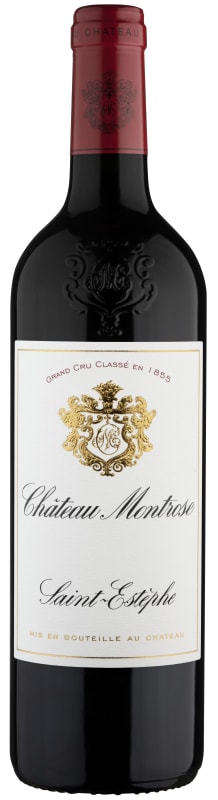


Winemaker Notes
Professional Ratings
-
Jeb Dunnuck
One of the wines of the vintage, the 2023 Château Montrose sports a vivid purple hue as well as awesome aromatics of crème de cassis, fresh blackcurrants, graphite, crushed stone, tobacco, and violets. It's medium to full-bodied and has a concentrated, layered, seamless mouthfeel, flawless balance, fine polished tannins, and a blockbuster of a finish. Based on 75% Cabernet Sauvignon, 21% Merlot, and 4% Cabernet Franc and aged 18 months in 60% new French oak, it stays in the more aristocratic style of the vintage and is an utterly sensational, deep, multi-dimensional Montrose. It's one for the ages, yet I suspect it will be approachable within a reasonable time frame as well. Drink 2030-2078.
-
James Suckling
A new benchmark for Montrose. Extremely aromatic and beautiful, with lavender, violets, pencil shavings and black currants on the nose. Complex and medium-bodied. The muscular structure and intensity are something else. The purity of fruit is dreamy. Marks a new era for Montrose. It is now made from only 45 hectares of vineyards right in front of the chateau instead of about 60 hectares before. From organically grown grapes. 75% cabernet sauvignon, 21% merlot and 4% cabernet franc.
-
Robert Parker's Wine Advocate
Just as it was from barrel, the 2023 Montrose is one of the most compelling wines of the vintage. Unwinding in the glass with a brooding bouquet of cassis, violets and burning embers, it's full-bodied, with prodigious mid-palate density and dimension, its concentrated core of fruit underpinned by abundant but ultra-refined tannins and lively acids. Broad, penetrating and persistent, it's a blend of 75% Cabernet Sauvignon, 21% Merlot and 4% Cabernet Franc. This is a very serious wine, carrying plenty of structure; but while it will certainly require some patience, today's more precise extraction and élevage choices mean that it will not mandate the 20-30 years of deferred gratification that were once the norm at this address, even if I'm convinced the 2023 will be just as long-lived as the classics of the past. Rating: 99+
-
Decanter
So floral and aromatic, really inviting and welcoming on the nose, more aromatic than some. Smooth and intense, clearly concentrated but supple and bouncy, there’s movement to this, it’s not strict. So precise, and finessed, you can feel the edges of the fine tannins - well executed with a mineral grip underneath. You can tell there’s power here, it has muscles but sinew also. Quite demonstrative really - it’s flexing but keeps such a clear line of focus and cool blue fruit with graphite and liquorice too. Round and penetrating with an excellent weight and balance of acidity in the mouth while keeping harmony alongside a hint of sweet and just-ripe strawberries mostly with crunchy cranberry too. A lot to like here. Great effort, classy and comfortable - multi-faceted while still being so juicy and approachable. 60% new oak, ageing in barrels only for 18 months. 3.7pH. 13.6% press wine (300 barrels of press split into seven qualities). 35% grand vin in total, mainly from the old vines which is 45% of the vineyard but 35% of the crop. 48hl/ha yield.
Barrel Sample: 98 -
Vinous
The 2023 Montrose is focused on the original terroir of the estate, known as Terrace 4, located in front of the river. It comprises 45 hectares, around 12 to 15 hectares less than previous vintages so as to capture the expression of Montrose classified in 1855. Picked from September 5 to 28 and matured in 60% new oak, this has a very intense and focused bouquet: pure black fruit with just a touch of strawberry, hints of violet petals developing in the glass. The palate is medium-bodied with fine-boned tannins—very pure, with pitch-perfect acidity. This gains depth toward the finish but maintains a sense of linearity that ensures it is one of the vintage’s finest contributions from the Left Bank. Magnificent. –Neal Martin
Barrel Sample: 96-98 -
Wine Spectator
Dense but purely rendered, offering violet, ink and lilac notes that stream through in unison with the core of cassis, damson plum and bitter cherry puree. A chalky underpinning runs from start to finish, providing a lovely ground wire and a sense of refinement. The terroir speaks quite clearly. Cabernet Sauvignon, Merlot and Cabernet Franc. Best from 2027 through 2043. 10,000 cases made, 1,200 cases imported.


One of the world’s most classic and popular styles of red wine, Bordeaux-inspired blends have spread from their homeland in France to nearly every corner of the New World. Typically based on either Cabernet Sauvignon or Merlot and supported by Cabernet Franc, Malbec and Petit Verdot, the best of these are densely hued, fragrant, full of fruit and boast a structure that begs for cellar time. Somm Secret—Blends from Bordeaux are generally earthier compared to those from the New World, which tend to be fruit-dominant.

Deeply colored, concentrated, and distinctive, St. Estephe is the go-to for great, age-worthy and reliable Bordeaux reds. Separated from Pauillac merely by a stream, St. Estephe is the farthest northwest of the highest classed villages of the Haut Medoc and is therefore subject to the most intense maritime influence of the Atlantic.
St. Estephe soils are rich in gravel like all of the best sites of the Haut Medoc but here the formation of gravel over clay creates a cooler atmosphere for its vines compared to those in the villages farther downstream. This results in delayed ripening and wines with higher acidity compared to the other villages.
While they can seem a bit austere when young, St. Estephe reds prove to live very long in the cellar. Traitionally dominated by Cabernet Sauvignon, many producers now add a significant proportion of Merlot to the blend, which will soften any sharp edges of the more tannic, Cabernet.
The St. Estephe village contains two second growths, Chateau Montrose and Cos d’Estournel.