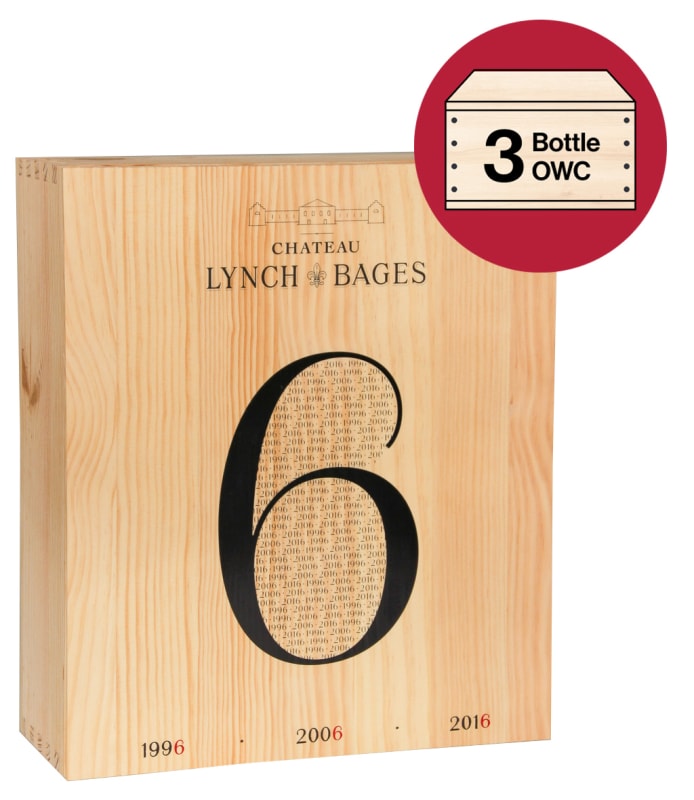


Winemaker Notes
This vertical three-pack includes one bottle each of Château Lynch-Bages 1996, 2006 & 2016.
- 1 Bottle of 1996 Château Lynch-Bages
A great vintage shaped by exceptionally favorable ripening and harvesting conditions. Lynch-Bages 1996 stands out for its remarkable balance, complexity, and distinguished aromatic profile. - 1 Bottle of 2006 Château Lynch-Bages
Classicism and maturity define this vintage. Lynch-Bages 2006 reveals itself as broad and captivating. The tannins are rich and silky, leading into a finish of remarkable power and exceptional length. - 1 Bottle of 2016 Château Lynch-Bages
2016 reveals the hallmarks of a remarkably mature vintage, where concentration and freshness come together with precision. An intense expression of black fruit aromas, exceptional depth, and supple, well-integrated tannins.
Professional Ratings
-
James Suckling
2016: Very rich and exotic with blackberry, black-tea, graphite and lead-pencil aromas. Full-bodied, dense and structured with lots of ripe tannins and a long, flavorful finish of currants and forest floor, combined with fresh mushrooms and bark. Needs four to five years to show its true potential. Try after 2024.
-
Robert Parker's Wine Advocate
2016: Deep garnet-purple colored, the 2016 Lynch Bages comes charging out of the gate with pronounced cassis, chocolate-covered cherries, mulberries and menthol notions, backed up by scents of garrigue, tilled soil and a waft of tapenade. Medium to full-bodied, rich and fantastically concentrated, the generous fruit is superbly framed by firm, ripe, grainy tannins with tons of pepper, cinnamon and cloves layers coming through on the finish. Truly, a legendary Lynch Bages!
Rating: 97+ -
Wine Spectator
2016: This is built for the cellar, with a generous core of kirsch, raspberry paste and plum preserve flavors waiting to unfurl. Will take time, due to the licorice snap, roasted apple wood and sweet tobacco elements draped over the fruit. Should meld with age, as the structure is invigorating in feel, showing both acidity and tannins in lockstep with the fruit. Best from 2025 through 2040.
-
Wine Enthusiast
2006: Year after year, Lynch-Bages is able to produce sumptuous wines, typically rich, powerful and structured. This is solid, the blackberry ripe fruit enveloping this structure with a velvet sheen. This is developing into one of the successes of the vintage.
-
Robert Parker's Wine Advocate
2006: Tasted at Bordeaux Index's annual 10-Year On tasting in London. The 2006 Château Lynch Bages has another quite vivacious bouquet with lively black cherries, kirsch and wild mint aromas that do not hold back. I love the purity here. The palate is medium-bodied with fine supple tannin, well-judged acidity, a gentle grip in the mouth, and plenty of lightly spiced and surprisingly intense fruit on the bravura finish. The Cazes family oversaw a very sophisticated Lynch-Bages in this vintage that may well surpass many peoples' expectations.
-
Wine Spectator
1996: This is much more open than the 1995. Offers aromas and flavors of currant, mint and spices. Full-bodied, soft and velvety, with a fruit finish.
-
Wine Spectator
2006: Blackberry, licorice and mint aromas lead to a full-bodied palate, with velvety tannins and lots of blackberry and mineral fruit character. Shows outstanding concentration and balance.
-
Robert Parker's Wine Advocate
1996: The 1996 Lynch Bages has a delightful fresh, minty bouquet that does not quite deliver the complexity of recent vintages, nicely perfumed with hints of wilted rose petal developing with time. The palate is well balanced with a fine line of acidity, fresh from the start with blackcurrant pastilles, a touch of tobacco with a tightly coiled, minerally, slightly sharp finish that perhaps just needs a little more depth. I appreciate that lingering pencil lead note on the aftertaste, completing a solid if unspectacular Lynch Bages. It's the kind of Pauillac I would grab from a restaurant list at the right price.


One of the world’s most classic and popular styles of red wine, Bordeaux-inspired blends have spread from their homeland in France to nearly every corner of the New World. Typically based on either Cabernet Sauvignon or Merlot and supported by Cabernet Franc, Malbec and Petit Verdot, the best of these are densely hued, fragrant, full of fruit and boast a structure that begs for cellar time. Somm Secret—Blends from Bordeaux are generally earthier compared to those from the New World, which tend to be fruit-dominant.

The leader on the Left Bank in number of first growth classified producers within its boundaries, Pauillac has more than any of the other appellations, at three of the five. Chateau Lafite Rothschild and Mouton Rothschild border St. Estephe on its northern end and Chateau Latour is at Pauillac’s southern end, bordering St. Julien.
While the first growths are certainly some of the better producers of the Left Bank, today they often compete with some of the “lower ranked” producers (second, third, fourth, fifth growth) in quality and value. The Left Bank of Bordeaux subscribes to an arguably outdated method of classification that goes back to 1855. The finest chateaux in that year were judged on the basis of reputation and trading price; changes in rank since then have been miniscule at best. Today producers such as Chateau Pontet-Canet, Chateau Grand Puy-Lacoste, Chateau Lynch-Bages, among others (all fifth growth) offer some of the most outstanding wines in all of Bordeaux.
Defining characteristics of fine wines from Pauillac (i.e. Cabernet-based Bordeaux Blends) include inky and juicy blackcurrant, cedar or cigar box and plush or chalky tannins.
Layers of gravel in the Pauillac region are key to its wines’ character and quality. The layers offer excellent drainage in the relatively flat topography of the region allowing water to run off into “jalles” or streams, which subsequently flow off into the Gironde.