


Winemaker Notes
Pale gold color with green highlights. Elegant notes of lemon and white flower on the nose. The palate has a nice minerality and length.
Professional Ratings
-
Wine Spectator
A well-crafted white, with creamed orchard fruit mixed with a bedrock of mineral energy. Richly styled yet perfectly balanced, with quinine-edged acidity keeping this focused and pure. Delivers nice details of dried chamomile and heather, ultimately showing the beauty and potential of Clairette in this region. Drink now through 2030. 162 cases made, 30 cases imported.
-
Vinous
A single-varietal Clairette, the 2022 Châteauneuf-du-Pape Blanc Les Clairettes de Gabriel aged for nine months in 50/50 new and old oak barriques. Prominent straw, lemon peel, crushed flower, apple skin, cedar and discrete vanilla notes are all brought forward. Full-bodied, rich and expressive, this is an excellent white Châteauneuf from Château de Vaudieu. It closes with good length on the layered finale.

Full-bodied and flavorful, white Rhône blends originate from France’s Rhône Valley. Today these blends are also becoming popular in other regions. Typically some combination of Grenache Blanc, Marsanne, Roussanne and Viognier form the basis of a white Rhône blend with varying degrees of flexibility depending on the exact appellation. Somm Secret—In the Northern Rhône, blends of Marsanne and Roussanne are common but the south retains more variety. Marsanne, Roussanne as well as Bourboulenc, Clairette, Picpoul and Ugni Blanc are typical.

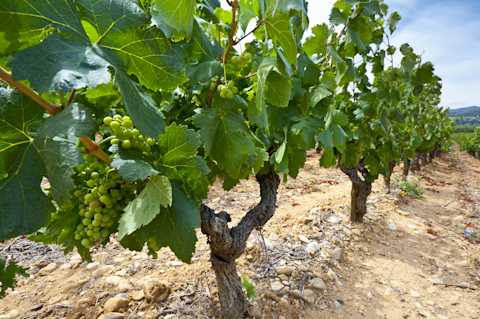
Famous for its full-bodied, seductive and spicy reds with flavor and aroma characteristics reminiscent of black cherry, baked raspberry, garrigue, olive tapenade, lavender and baking spice, Châteauneuf-du-Pape is the leading sub-appellation of the southern Rhône River Valley. Large pebbles resembling river rocks, called "galets" in French, dominate most of the terrain. The stones hold heat and reflect it back up to the low-lying gobelet-trained vines. Though the galets are typical, they are not prominent in every vineyard. Chateau Rayas is the most obvious deviation with very sandy soil.
According to law, eighteen grape varieties are allowed in Châteauneuf-du-Pape and most wines are blends of some mix of these. For reds, Grenache is the star player with Mourvedre and Syrah coming typically second. Others used include Cinsault, Counoise and occasionally Muscardin, Vaccarèse, Picquepoul Noir and Terret Noir.
Only about 6-7% of wine from Châteauneuf-du-Pape is white wine. Blends and single-varietal bottlings are typically based on the soft and floral Grenache Blanc but Clairette, Bourboulenc and Roussanne are grown with some significance.
The wine of Chateauneuf-du-Pape takes its name from the relocation of the papal court to Avignon. The lore says that after moving in 1309, Pope Clément V (after whom Chateau Pape-Clément in Pessac-Léognan is named) ordered that vines were planted. But it was actually his successor, John XXII, who established the vineyards. The name however, Chateauneuf-du-Pape, translated as "the pope's new castle," didn’t really stick until the 19th century.