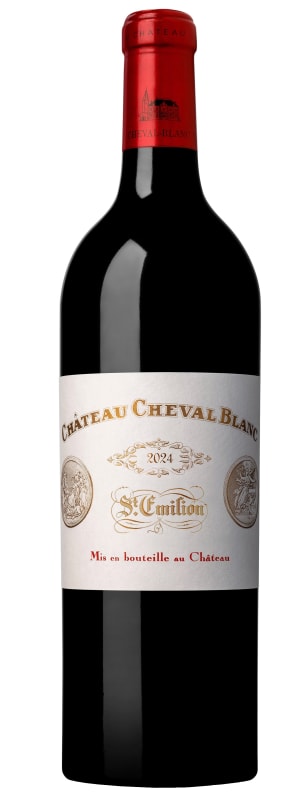


Winemaker Notes
Blend: 48% Cabernet Franc, 46% Merlot, 6% Cabernet Sauvignon
This wine does not include the blanket 10% tariff imposed in April 2025. When the wines are shippable in fall of 2027, customers will have the option to pay any tariff in place at the time or to keep their wines stored in a temperature-controlled facility free of charge in France.
Professional Ratings
-
James Suckling
So succulent and long on the compacted palate, this shows just enough clean ripe berries as well as cedar and chocolate. This has polished, energizing tannins with a lovely and thoughtful drive, the light austerity giving the wine a push in the finish. Only 12.8% alcohol. A blend of 46% merlot, 48% cabernet franc and 6% cabernet sauvignon.
Barrel Sample: 96-97 -
Jeb Dunnuck
Comprised of 37 parcels on the estate and a blend of 48% Cabernet Franc, 46% Merlot, and 6% Cabernet Sauvignon, the 2024 Château Cheval Blanc will spend at least 18 months in new barrels. Classic Cheval Blanc Cabernet notes of cassis, spring flowers, graphite, and scorched earth all emerge on the nose, and this beauty is medium to full-bodied, has a beautiful mid-palate, the focused, elegant style of the vintage, and impressive concentration. It's an elegant, very classic Bordelaise vintage for this estate, and the wine will need just 4-6 years of bottle age and will evolve gracefully.
Barrel Sample: 94-96+ -
Robert Parker's Wine Advocate
A blend of 48% Cabernet Franc, 48% Merlot and the rest Cabernet Sauvignon, the 2024 Château Cheval Blanc is one of the stars of the vintage. Unwinding in the glass with notes of minty berries and plums mingled with violets, cigar wrapper and rose petals, it's medium-bodied, suave and complete, with a cool, layered core of fruit, beautifully integrated tannins and a long, aromatic finish. Pierre-Olivier Clouet and his team conducted an aggressive green harvest and also, exceptionally, used densimetric sorting to mitigate heterogenous maturity between and within bunches (a consequence of a protracted flowering), accepting losses to rot in pursuit of full maturity. Yields were 39 hectoliters per hectare at harvest, but some 34% of that was eliminated between sorting and press wine (which is never retained at Cheval Blanc). Of what fermented, however, 70% ended up in the grand vin.
Barrel Sample: 94-96 -
Decanter
Strawberry and red berry fragrance, a touch herbal, milk chocolate, florality with blackcurrant and cherry. Smooth and supple, this has a softly chalky, almost creamy charm with blue fruits on the palate. Light weight and delicate for sure, but the tannins are extremely well incorporated giving this a round frame. Finessed, not too tight at all, relaxed. More vertical acidity behind that pushes the flavours forward. Layered and complex with the saltiness coming in on the finish. It’s easy to drink and super refreshing. Classic but with charm rather than tension and too much coolness. Really balanced but still nuanced on the finish, this is multi-layered. I like this a lot. 3.61pH. Densimetric sorting. 70% grand vin production. Vinified 28hl/ha.
Barrel Sample: 95 -
Vinous
The 2024 Cheval Blanc was picked from September 18 until October 3 and aged entirely in new oak with a little dabbling in concrete tanks and amphorae. The purity on the nose is the first facet that you notice with perfumed black cherry, blackcurrant, wild strawberry and touches of potpourri and crushed stone. There is certainly some mineralité here. The palate is medium-bodied with slightly brittle tannins. Very well balanced, this is clearly a Cheval Blanc built in a more elegant, sapid, linear style with a residual pepperiness that lingers in the mouth. It will need just 2 or 3 years in bottle and should drink well for 20 to 25 years. The 2024 is charming and refined. –Neal Martin
Barrel Sample: 93-95


One of the world’s most classic and popular styles of red wine, Bordeaux-inspired blends have spread from their homeland in France to nearly every corner of the New World. Typically based on either Cabernet Sauvignon or Merlot and supported by Cabernet Franc, Malbec and Petit Verdot, the best of these are densely hued, fragrant, full of fruit and boast a structure that begs for cellar time. Somm Secret—Blends from Bordeaux are generally earthier compared to those from the New World, which tend to be fruit-dominant.

Marked by its historic fortified village—perhaps the prettiest in all of Bordeaux, the St-Émilion appellation, along with its neighboring village of Pomerol, are leaders in quality on the Right Bank of Bordeaux. These Merlot-dominant red wines (complemented by various amounts of Cabernet Franc and/or Cabernet Sauvignon) remain some of the most admired and collected wines of the world.
St-Émilion has the longest history in wine production in Bordeaux—longer than the Left Bank—dating back to an 8th century monk named Saint Émilion who became a hermit in one of the many limestone caves scattered throughout the area.
Today St-Émilion is made up of hundreds of independent farmers dedicated to the same thing: growing Merlot and Cabernet Franc (and tiny amounts of Cabernet Sauvignon). While always roughly the same blend, the wines of St-Émilion vary considerably depending on the soil upon which they are grown—and the soils do vary considerably throughout the region.
The chateaux with the highest classification (Premier Grand Cru Classés) are on gravel-rich soils or steep, clay-limestone hillsides. There are only four given the highest rank, called Premier Grand Cru Classés A (Chateau Cheval Blanc, Ausone, Angélus, Pavie) and 14 are Premier Grand Cru Classés B. Much of the rest of the vineyards in the appellation are on flatter land where the soils are a mix of gravel, sand and alluvial matter.
Great wines from St-Émilion will be deep in color, and might have characteristics of blackberry liqueur, black raspberry, licorice, chocolate, grilled meat, earth or truffles. They will be bold, layered and lush.