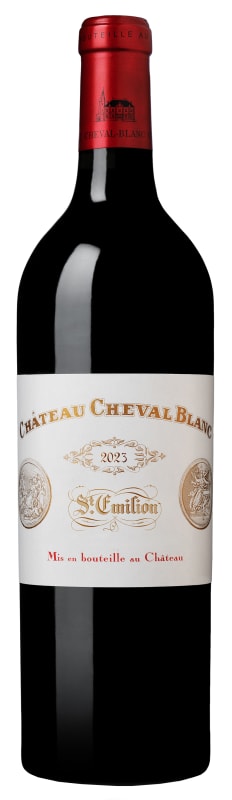


Winemaker Notes
A generous vintage, loyal reflection of its climatic conditions, expressing the unique nature of each parcel.
Blend: 52% Merlot, 46% Cabernet Franc, 2% Cabernet Sauvignon
Professional Ratings
-
Robert Parker's Wine Advocate
From bottle, the 2023 Château Cheval Blanc is one of the most compelling wines of the vintage, just as it was from cask. Bursting with aromas of cherries and mulberries mingled with notions of violets, rose petal and anise, it's full-bodied, velvety and layered, with a deep and enveloping core of vibrant fruit, ripe tannins and a long, expansive finish. It's a blend of 52% Merlot, 46% Cabernet Franc and 2% Cabernet Sauvignon, drawing on fully 46 of the blocks that make up Cheval Blanc, and it attained 13.8% alcohol.
-
James Suckling
Blackberry and dark-chocolate aromas with bark, mushrooms, stems, flint, lead pencil and a hint of violets. Medium-bodied with a toned structure from the tight, compressed palate and fine, polished tannins. Extremely long. A blend of 52% merlot, 46% cabernet franc and 2% cabernet sauvignon. Best after 2029.
-
Jeb Dunnuck
A blend of 52% Merlot, 46% Cabernet Franc, and 2% Cabernet Sauvignon raised just about all in new barrels, with a tiny amount in once-used barrels and foudre (roughly 10% of the blend), the 2023 Château Cheval Blanc is an absolutely quintessential Cheval Blanc that's all about complexity, finesse, and elegance. Blackcurrants, mulberries, graphite, spicy wood, smoke, and crushed stone-driven aromatics slowly pick up a kiss of violets and flowers with time in the glass. It's beautifully textured, medium to full-bodied, and flawlessly balanced, with ripe, polished tannins and a gorgeous finish. It's possibly in the same family as the 2019 and is going to shine with 5-7 years of bottle age and evolve for 30+ years on its balance and overall harmony.
-
Vinous
The 2023 Cheval Blanc is silky, elegant and exceptionally polished. Cabernet Franc is rarely as expressive as it is here. Everything in the 2023 is about detail. All the elements are so well balanced—so integrated. Red/purplish berry fruit, mint, cinnamon, rose petal and blood orange meld together, while seamless tannins wrap it all up in grand style. What a wine. –Antonio Galloni
Barrel Sample: 95-98 -
Decanter
Fresh and floral on the nose, cool and crisp aromas. Purple flowers, red and purple berries with crayon, graphite and liquorice. Gorgeous texture on the palate, this has grip and bite, tannins are present and quite imposing, really coating the mouth with a powdery, chalkiness. It has some layers of tannin and ripe fruit but with freshness and lift all the way through. It’s not immediately charming and generous, it’s more controlled, but not strict. Fresh, clean, precise with style and finesse and this packs more power than some. Raspberries, chalky cherries, bright blueberries with wet stones, lots of liquorice and slate. Balanced and containing both warm and cool vintage markers - lots of complexity on offer. It’s missing a touch of that gorgeous charm that Cheval does so well, a sense of enrobing, but it’s very well constructed with lots of personality. The largest ever vintage in the Cheval cellars with a yield of 40hl/ha. 3.82pH.
Barrel Sample: 97 -
Wine Spectator
This impressive red lets warm paving stone, smoldering tobacco and iris hints peek out from behind its prodigious core of cassis and plum reduction, before a cascade of black tea and loam asserts itself on the finish. Broad and deep but doesn’t try to outmuscle the vintage, staying poised and focused through the long finish. Merlot, Cabernet Franc and Cabernet Sauvignon.


One of the world’s most classic and popular styles of red wine, Bordeaux-inspired blends have spread from their homeland in France to nearly every corner of the New World. Typically based on either Cabernet Sauvignon or Merlot and supported by Cabernet Franc, Malbec and Petit Verdot, the best of these are densely hued, fragrant, full of fruit and boast a structure that begs for cellar time. Somm Secret—Blends from Bordeaux are generally earthier compared to those from the New World, which tend to be fruit-dominant.

Marked by its historic fortified village—perhaps the prettiest in all of Bordeaux, the St-Émilion appellation, along with its neighboring village of Pomerol, are leaders in quality on the Right Bank of Bordeaux. These Merlot-dominant red wines (complemented by various amounts of Cabernet Franc and/or Cabernet Sauvignon) remain some of the most admired and collected wines of the world.
St-Émilion has the longest history in wine production in Bordeaux—longer than the Left Bank—dating back to an 8th century monk named Saint Émilion who became a hermit in one of the many limestone caves scattered throughout the area.
Today St-Émilion is made up of hundreds of independent farmers dedicated to the same thing: growing Merlot and Cabernet Franc (and tiny amounts of Cabernet Sauvignon). While always roughly the same blend, the wines of St-Émilion vary considerably depending on the soil upon which they are grown—and the soils do vary considerably throughout the region.
The chateaux with the highest classification (Premier Grand Cru Classés) are on gravel-rich soils or steep, clay-limestone hillsides. There are only four given the highest rank, called Premier Grand Cru Classés A (Chateau Cheval Blanc, Ausone, Angélus, Pavie) and 14 are Premier Grand Cru Classés B. Much of the rest of the vineyards in the appellation are on flatter land where the soils are a mix of gravel, sand and alluvial matter.
Great wines from St-Émilion will be deep in color, and might have characteristics of blackberry liqueur, black raspberry, licorice, chocolate, grilled meat, earth or truffles. They will be bold, layered and lush.