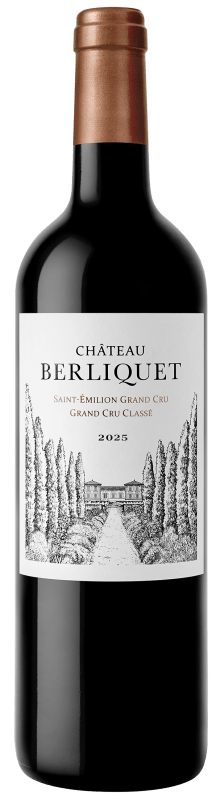


Winemaker Notes
Right from the opening, the wine sets its pace. It starts with dark, almost blood-like fruit, lifted by brighter notes of anise and spice. Then the texture comes alive—tightening, drawing in. It moves forward, carried by a steady, contained intensity that gives it both rhythm and direction. The limestone plateau comes through, bringing a freshness that cuts, shapes, and drives it onward. The tannins have a fine, tactile grain. The wine vibrates, flows, never weighing itself down. The acidity is precise, stretching the line and extending that sense of momentum. A Berliquet that mirrors its landscape: alive.
Blend: 61% Merlot, 39% Cabernet Franc
Professional Ratings
-
Jeb Dunnuck
A Merlot-led blend of 61% Merlot and 39% Cabernet Franc, the 2025 Château Berliquet is currently resting in 38% new barrels with 23% in amphora. The nose shows incredibly pure red and black fruits, chocolaty herbs, graphite, and classic Saint-Emilion minerality. On the palate, it's medium to full-bodied, pretty, pure, and elegant, with fine-grained tannins, moderate concentration, nicely integrated acidity, and a solid finish. It's pure, polished, and just flawlessly balanced. Checking in at 14% alcohol with a pH of 3.5, the 2025 might be the greatest Berliquet to date.
Barrel Sample: 95-97 -
Robert Parker's Wine Advocate
A blend of 61% Merlot and 39% Cabernet Franc, the 2025 Berliquet is the best wine to emerge from this ascendent property yet. Bursting with aromas of sweet dark berries, licorice and violets, it's medium- to full-bodied, rich and suave, with beautifully refined tannins, lively acids and a seamless, complete profile. The estate's new winery, inaugurated with the 2023 vintage, permits harvesting block by block with greater precision. Readers who haven't been following Berliquet's progress should make a special effort to seek out the superb 2025.
Barrel Sample: 95-97 -
James Suckling
Well composed, textured and precise, with aromas of dark berries and stones. Medium-bodied with fine tannins. Driven and layered with a long, vivid finish.
Barrel Sample: 93-94 -
Vinous
The 2025 Berliquet is precise, elegant and nuanced—adjectives I have not used often here, but that sum up the level of the 2025. Floral overtones, red berry fruit, mint and spice are beautifully delineated in the glass. The 2025 opens beautifully with a bit of time, showing notable breadth and layers. This is the finest Berliquet since Chanel's acquisition in 2017. Tasted two times. –Antonio Galloni
Barrel Sample: 92-94

One of the world’s most classic and popular styles of red wine, Bordeaux-inspired blends have spread from their homeland in France to nearly every corner of the New World. Typically based on either Cabernet Sauvignon or Merlot and supported by Cabernet Franc, Malbec and Petit Verdot, the best of these are densely hued, fragrant, full of fruit and boast a structure that begs for cellar time. Somm Secret—Blends from Bordeaux are generally earthier compared to those from the New World, which tend to be fruit-dominant.

Marked by its historic fortified village—perhaps the prettiest in all of Bordeaux, the St-Émilion appellation, along with its neighboring village of Pomerol, are leaders in quality on the Right Bank of Bordeaux. These Merlot-dominant red wines (complemented by various amounts of Cabernet Franc and/or Cabernet Sauvignon) remain some of the most admired and collected wines of the world.
St-Émilion has the longest history in wine production in Bordeaux—longer than the Left Bank—dating back to an 8th century monk named Saint Émilion who became a hermit in one of the many limestone caves scattered throughout the area.
Today St-Émilion is made up of hundreds of independent farmers dedicated to the same thing: growing Merlot and Cabernet Franc (and tiny amounts of Cabernet Sauvignon). While always roughly the same blend, the wines of St-Émilion vary considerably depending on the soil upon which they are grown—and the soils do vary considerably throughout the region.
The chateaux with the highest classification (Premier Grand Cru Classés) are on gravel-rich soils or steep, clay-limestone hillsides. There are only four given the highest rank, called Premier Grand Cru Classés A (Chateau Cheval Blanc, Ausone, Angélus, Pavie) and 14 are Premier Grand Cru Classés B. Much of the rest of the vineyards in the appellation are on flatter land where the soils are a mix of gravel, sand and alluvial matter.
Great wines from St-Émilion will be deep in color, and might have characteristics of blackberry liqueur, black raspberry, licorice, chocolate, grilled meat, earth or truffles. They will be bold, layered and lush.