


Winemaker Notes
Ruby red with nuances of violet. Intense aromas of ripe red berries. Soft and elegant, with flavors of red berry fruit and a pleasant acidity, leading to a lingering.
Enjoy with antipasto, grilled meats, burgers and Italian specialties.
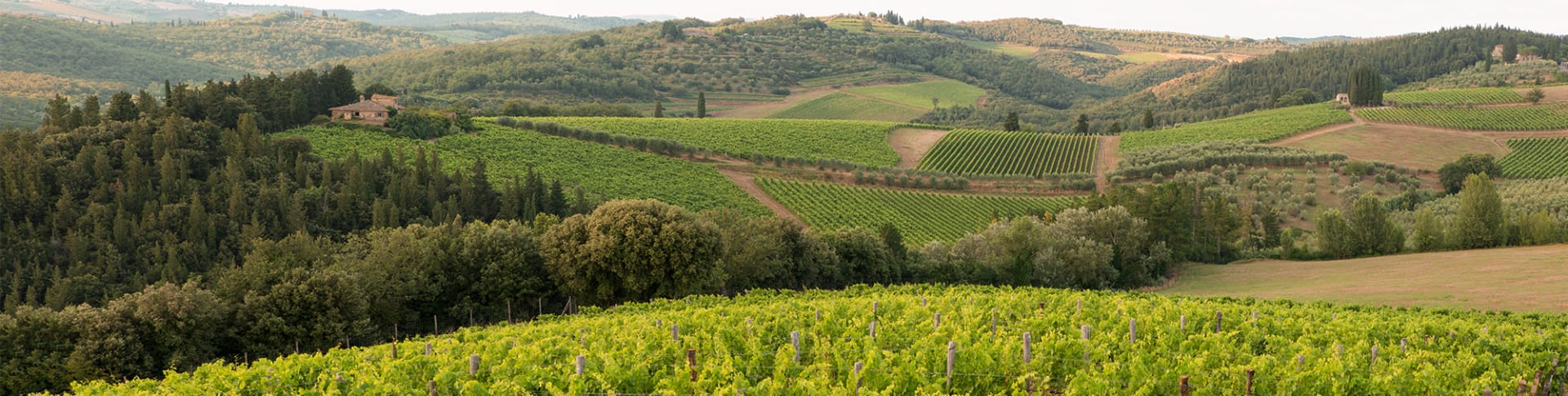




The Castello di Monsanto estate was established by Fabrizio Bianchi in the hillsides of Barberino Val d’Elsa in the province of Florence in the north-central reaches of the Chianti Classico denomination. Bianchi worked to clear a vineyard he named “Il Poggio” (“The Hill”), which would be utilized for production of a single vineyard wine riserva, the first example in Chianti Classico. Always the pioneer, Bianchi began to eliminate the white varieties, Malvasia and Trebbiano, from his Chianti Classico in 1968, preferring to use only the traditional red varieties of Sangiovese, Canaiolo and Colorino.
Cellar innovations in the early years included Slovenian casks for aging, instead of old chestnut barrel, as well as the introduction of stainless steel tanks for fermentation. Furthermore, Castello di Monsanto harvested the first 100% Cabernet Sauvignon, ‘Nemo,’ from the ‘Il Mulino’ vineyard. Today, the Monsanto estate totals 500 acres, of which slightly more than half are woods, while olive orchards occupy an additional 37 acres. Vineyards, situated between 800 and 1,000 feet above sea level, account for 175 acres. Three quarters of the plantings are Sangiovese, the basis for Chianti Classico, while Cabernet Sauvignon and Merlot are the next most widely planted varieties.
One of the most impressive components of Castello di Monsanto is the cellar and its underground tunnel, some 820 feet in length that serves as an aging cellar as well for a potential total of 1,500 barriques. This cave system, one of the most dazzling in all of Italy, took six years to build by hand. The gallery, connecting the new cellar with the original, is located underneath the castle and dates back to 1740.
Today, Fabrizio Bianchi and his daughter, Laura, represent the tradition and elegance that have been associated with the estate throughout its existence. “Il Poggio” was not just an innovation back in 1962; it truly represented a new vision for Chianti Classico. Today, each new vintage is eagerly anticipated as one of the very best bottlings of this wine type.
Each of the wines of Castello di Monsanto, from the award-winning Chianti Classico Riserva, to ‘Nemo’, a Super Tuscan, to the lush and exotic Vin Santo ‘La Chimera’, are true Tuscan treasures. Simply what you would expect from Castello di Monsanto, the grand jewel in the heart of Tuscany.

Among Italy's elite red grape varieties, Sangiovese has the perfect intersection of bright red fruit and savory earthiness and is responsible for the best red wines of Tuscany. While it is best known as the chief component of Chianti, it is also the main grape in Vino Nobile di Montepulciano and reaches the height of its power and intensity in the complex, long-lived Brunello di Montalcino. Somm Secret—Sangiovese doubles under the alias, Nielluccio, on the French island of Corsica where it produces distinctly floral and refreshing reds and rosés.

Famous for its food-friendly, approachable red wines and their storied history, Chianti is perhaps the best-known wine region of Italy. This appellation within Tuscany has it all: sweeping views of rolling hills, endless vineyards, the warm Mediterranean sun, hearty cuisine and a rich artistic heritage. Chianti includes seven subzones: Chianti Colli Fiorentini, Rufina, Montalbano, Colli Senesi, Colline Pisane, Colli Aretini and Montespertoli, with area beyond whose wines can be labeled simply as Chianti.
However the best quality comes from Chianti Classico, in the heart of the Chianti zone, which is no longer a subzone of the region at all but has been recognized on its own since 1996. The Classico region today is delimited by the confines of the original Chianti zone protected since the 1700s.
Chianti wines are made primarily of Sangiovese, with other varieties comprising up to 25-30% of the blend. Generally, local varieties are used, including Canaiolo, Colorino and Mammolo, but international varieties such as Cabernet Sauvignon, Merlot and Syrah are allowed as long as they are grown within the same zone.
Basic, value-driven Chianti wine is simple and fruit-forward and makes a great companion to any casual dinner. At its apex, Chianti is full bodied but with good acidity, firm tannins, and notes of tart red fruit, dried herbs, fennel, balsamic and tobacco. Chianti Riserva, typically the top bottling of a producer, can benefit handsomely from a decade or two of cellaring.