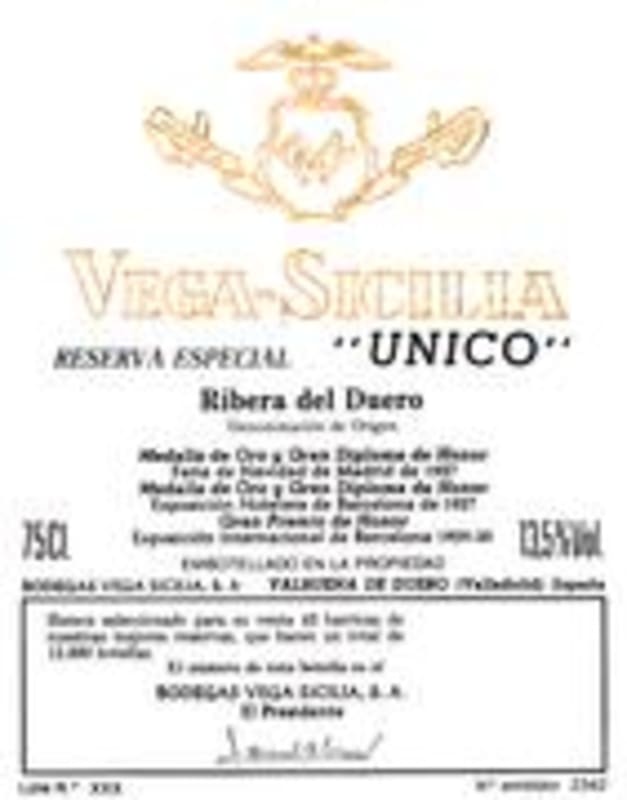

Winemaker Notes
Professional Ratings
-
Robert Parker's Wine Advocate
There were considerable issues with the 1968 Único in this tasting. One of the magnums had lost the cork, which had fallen into the wine, presumably during transport, and the wine was badly oxidized. They had brought two magnums of each vintage, and the second one of 1968 was badly corked. That was a bummer, because 1968 was also one of the greatest years from Vega Sicilia, and I was eager to try it from magnums. I've had a number of regular bottles, and they have been consistently great, lively and even young, with marked old Vega character. Given the exclusive audience that was difficult to gather together, they did the impossible to find another magnum, but it wouldn't make it in time for the tastings. But they did have a regular bottle that they poured between all the tasters; it was just enough for a taste and to realize that this is still on form and has life ahead of it.


Hailed as the star red variety in Spain’s most celebrated wine region, Tempranillo from Rioja, or simply labeled, “Rioja,” produces elegant wines with complex notes of red and black fruit, crushed rock, leather, toast and tobacco, whose best examples are fully capable of decades of improvement in the cellar.
Rioja wines are typically a blend of fruit from its three sub-regions: Rioja Alta, Rioja Alavesa and Rioja Oriental, although specific sub-region (zonas), village (municipios) and vineyard (viñedo singular) wines can now be labeled. Rioja Alta and Alavesa, at the highest elevations, are considered to be the source of the brightest, most elegant fruit, while grapes from the warmer and drier, Rioja Oriental, produce wines with deep color, great body and richness.