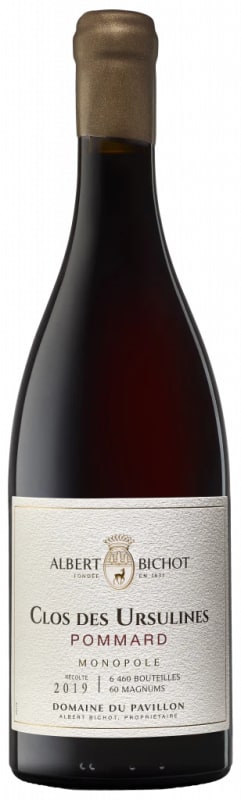


Winemaker Notes
This Pommard Clos des Ursulines reveals a fruity nose redolent of cherry, blackcurrant and fig. Over the years these aromas will evolve toward notes of coffee and leather. Full and round on the palate with ripe tannins and rich, but not heavy, substance. This wine is powerful and well-structured yet remains subtle, elegant and almost "feminine" due to the vineyard's proximity to Volnay. The finish is silky and velvety.
Serve with exquisitely prepared red meats, feathered game and wine sauces.
Professional Ratings
-
Wine Enthusiast
Dustings of crushed stone, ash and violet petals introduce this red-berried, satiny sip sourced from the southern end of Pommard near Volnay. Red-cherry and red-plum flavors on the palate are ripe but youthful and pure, accented by hints of fur and smoke and a lingering frame of fine-grained, sharply lingering tannins. It should approach peak by 2023 and improve through at least 2035.
-
James Suckling
Very attractive red-fruit nose with some floral notes and just a touch of smoky oak. An elegant wine for this appellation and you could easily mistake it for a Volnay. Very good depth, but also lovely freshness at the finish, which makes the tannins feel gentle. Long, elegant finish with a subtle, earthy touch.
-
Wine Spectator
A lush, polished style, whose texture is saturated with black cherry, blackberry, vanilla and toasty oak flavors. The underlying structure emerges on the lingering finish.





Since 1350, the Bichot family has called Burgundy home. But, it was in 1831 that Bernard Bichot founded a merchant house bearing his name in Monthélie, a couple of kilometers south of Beaune. At the end of the 19th century, his grandson Albert Bichot took the family business into a new direction and created the winery, Maison Albert Bichot as we know it. The family heritage has been perpetuated from father to son since then. The family crest, consisting of a deer and antlers, has been synonymous with the winery since its inception.
Since 1996, Albéric Bichot has represented the 6th generation managing the winery. The winery’s mission is to utilize the best fruit possible to create the best wine and best expression of terroir. In the constant pursuit of accomplishing this mission, Albert Bichot has acquired 250 acres of vineyards in the most reputed growing areas throughout Burgundy. In addition to this expertise as a wine-grower, Albert Bichot carefully sources grapes with an extremely hands-on approach, in order to vinify many of its regional and village wines, enabling them to supply high quality wines with continuity. For these grapes sourced from our partner growers, quality, and a close partnership, are of the utmost importance.
Albert Bichot owns 6 Domaines set at the heart of 5 great vinicultural regions that make up Burgundy: Chablis, Cote de Nuits, Cote de Beaune, Cote Chalonnaise, and Beaujolais. Each estate consists of vineyards cultivated with sustainable practices, as well as facilities, cellars and dedicated winemaking teams devoted to wines of that Domaine and region.
The 6 estates include:
- Domaine Long-Depaquit in Chablis
- Chateau Gris in the Cote de Nuits (Nuits-St.-Georges)
- Domaine du Clos-Frantin in the Cote de Nuits (Nuits-St.-Georges)
- Domaine du Pavillon in the Cote de Beaune (Pommard)
- Domaine Adelie in the Cote Chalonnaise (Mercurey)
- Domaine du Rochegres in Beaujolais (Moulin-à-Vent)

Thin-skinned, finicky and temperamental, Pinot Noir is also one of the most rewarding grapes to grow and remains a labor of love for some of the greatest vignerons in Burgundy. Fairly adaptable but highly reflective of the environment in which it is grown, Pinot Noir prefers a cool climate and requires low yields to achieve high quality. Outside of France, outstanding examples come from in Oregon, California and throughout specific locations in wine-producing world. Somm Secret—André Tchelistcheff, California’s most influential post-Prohibition winemaker decidedly stayed away from the grape, claiming “God made Cabernet. The Devil made Pinot Noir.”

Representing some of the darkest, deepest and sturdiest Pinot Noir of Burgundy, Pommard is one of the two villages in Côte de Beaune—along with Volnay—that is recognized for its impressive Pinot Noir. While it can’t boast any Grands Crus vineyards, its extraordinary Premiers Crus vineyards are aplenty.
Les Pézerolles, Les Épenots, Clos des Épeneaux, Les Chanlins, Les Jarolières, Les Fremiers and particularly Les Rugiens are among the most outstanding Premiers Crus.
The best Pommards will be concentrated in flavors such as black cherry, blackberry and dark chocolate, have dazzling aromas of violets, menthol or wild herbs and a firm and powerful finish. They typically demand some time in the bottle to reach their peak.