

Winemaker Notes
Dense, garnet-flecked ruby. Releases a rich medley of red currant, sweet spice, and pungent underbrush. Warm and rich in the mouth, with expressive tannins and smooth hints of vanilla. Perfect with grills and roasts, particularly game and lamb, and aged cheeses.
Blend: 35% Pugnitello, 30% Merlot, 30% Cabernet Sauvignon, 5% Petit Verdot
Professional Ratings
-
Robert Parker's Wine Advocate
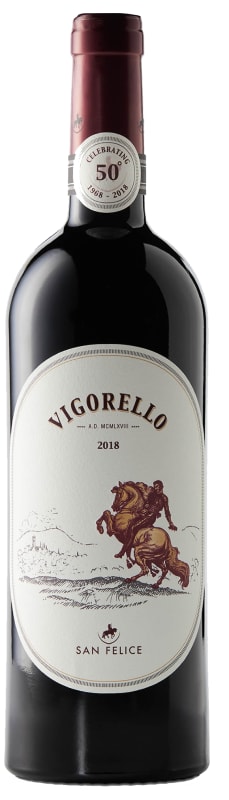
Celebrating its 50th anniversary (1968–2018) with a seal on the front label, the San Felice 2018 Vigorello is 35% Pugnitello, 30% Merlot, 30% Cabernet Sauvignon and 5% Petit Verdot. When the wine was first produced in 1968, it started off as a Sangiovese-based blend. Cabernet Sauvignon was added in 1979, and Merlot came later. Recently, Pugnitello and Petit Verdot were introduced and the Sangiovese was taken out completely. The Pugnitello (a grape named after the Italian word for "fist" due to its tight concentration) underlines the wine's black color and earthy notes of black truffle. The other grapes add concentration, structure and black fruit flavors. Best After 2024
-
Wine Spectator
Still marked by vanilla and new oak, but this has loads of blackberry, black cherry and plum fruit. It's rich without overextraction, boasting dense tannins, superb balance and a long finish. Pugnitello, Merlot, Cabernet Sauvignon and Petit Verdot. To be released in 2022 for Vigorello's 50th anniversary. —San Felice Vigorello Non-blind Retrospective (April 2021). Best from 2025 through 2050.
-
Decanter
The 35% of Pugnitello - a thick-skinned grape planted in Alberese chalky soil - gives this vintage a bracing character, while Cabernet Sauvignon and Merlot bring structure and suppleness. Clove and black pepper dominate the nose with cassis aromas and flavours enhanced by graphite minerality. Full and dense, this Vigorello flows... velvety and refreshing. In the context of the lean 2018 vintage, this has great concentration with ability to age. 'A surprising wine, it is recomposing itself in bottle' said Leonardo Bellaccini, winemaker and production manager for San Felice.
-
James Suckling
Very attractive blackberries and currants with hints of chocolate and fresh herbs, such as lemon grass. It’s medium-bodied with fine tannins and a fresh finish. Will age nicely, but why wait?


Legendary in Italy for its Renaissance art and striking landscape, Tuscany is also home to many of the country’s best red wines. Sangiovese reigns supreme here, as either the single varietal, or a dominant player, in almost all of Tuscany’s best.
A remarkable Chianti, named for its region of origin, will have a bright acidity, supple tannins and plenty of cherry fruit character. From the hills and valleys surrounding the medieval village of Montalcino, come the distinguished and age-worthy wines based on Brunello (Sangiovese). Earning global acclaim since the 1970s, the Tuscan Blends are composed solely of international grape varieties or a mix of international and Sangiovese. The wine called Vine Nobile di Montepulciano, composed of Prognolo Gentile (Sangiovese) and is recognized both for finesse and power.