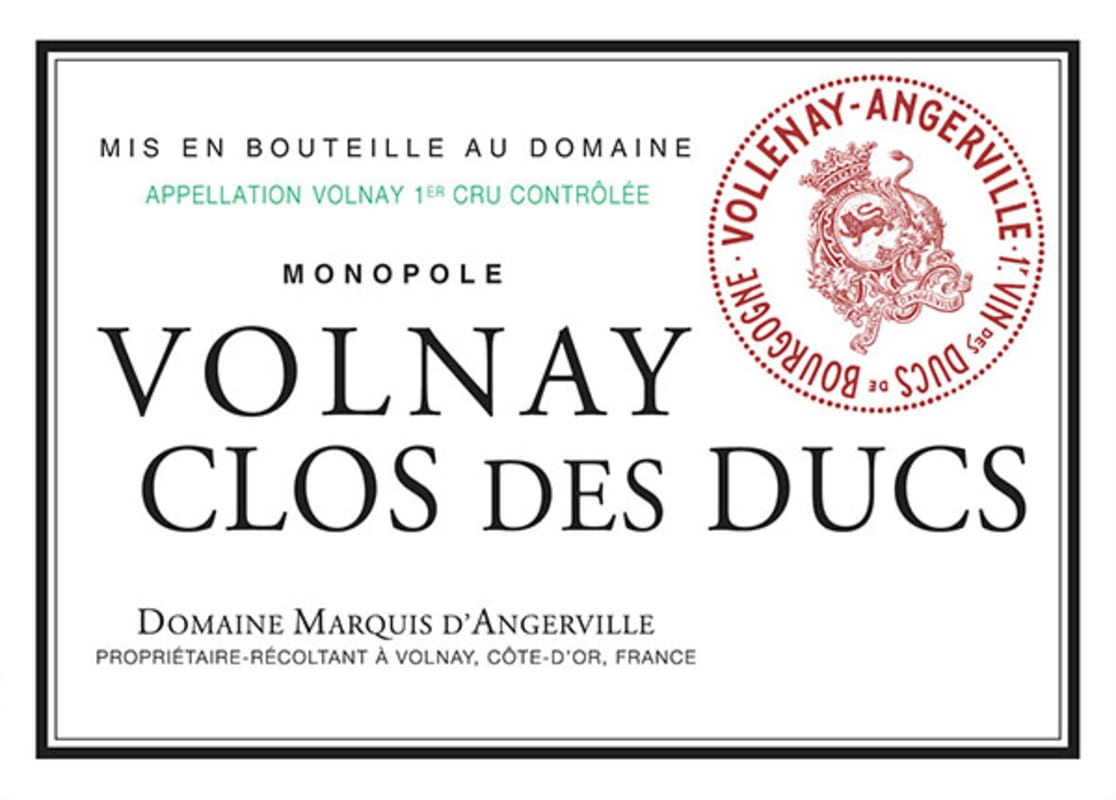

Winemaker Notes
This wine, firm and elegant at the same time, plays in a league of its own. Its structure is complex and harmonious. Ample aromas give it exceptional volume and rare distinction. A wine to keep, it evolves slowly in the bottle.
Professional Ratings
-
Vinous
The 2020 Volnay Clos des Ducs 1er Cru was picked around 23 August. It has a highly perfumed bouquet with rose petals, red cherries, raspberry and incenses, beautifully defined and wonderfully controlled. The palate also conveys a sense of effortlessness that is utterly beguiling. Very harmonious, balletically-poised thanks to its fine bead of acidity, this Clos des Ducs unfurls in the glass with a lilting, very pure and almost balletic finish. Quite saline on the aftertaste such that it urges you back for another sip. Sophisticated (as usual) yet delicious.
Barrel Sample: 95-97
-
Decanter
This iconic wine from the d’Angerville estate is a 2.15-hectare monopole that begins on the north side of the village and climbs up the white marl soils of the slope here, producing wines with a bright red berry fruit with notes of licorice, ginger, and violets. The wine is not as full-bodied as those south of the village, but with a lovely, silky character. D’Angerville explains that the aromas are 'almost peppery' and that recent vintages have delivered perfect conditions for Volnay.
Barrel Sample: 96
-
Jasper Morris
Pure deep crimson purple. Like the Champans, the nose here is also restrained though obviously with density to follow, when it is ready. The fruit swells across the palate, almost lush in the middle, some tannins too, firm at the finish. This is still very backward and has not completely filled out its framework yet. Maybe just a little riper than the perfect balance. Will be the last to be bottled, and has all the component parts to make a great wine.
Barrel Sample: 93-95
-
Robert Parker's Wine Advocate
Readers will have a fun time debating the relative merits of d'Angerville's 2018, 2019 and 2020 Volnay 1er Cru Clos des Ducs in 20 years' time, as for now it is a very close-run thing. The 2020 is certainly superb, wafting from the glass with aromas of sweet cherries, plums and berries mingled with spices, orange zest, peony and discreet hints of oak, followed by a medium to full-bodied, layered and seamless palate that's bright, elegant and rich but refined. Of the trio, it's probably the 2020 that carries the sunshine and warmth of the vintage the most lightly, even though the year was, on paper, the most extreme.
Rating: 95+


Thin-skinned, finicky and temperamental, Pinot Noir is also one of the most rewarding grapes to grow and remains a labor of love for some of the greatest vignerons in Burgundy. Fairly adaptable but highly reflective of the environment in which it is grown, Pinot Noir prefers a cool climate and requires low yields to achieve high quality. Outside of France, outstanding examples come from in Oregon, California and throughout specific locations in wine-producing world. Somm Secret—André Tchelistcheff, California’s most influential post-Prohibition winemaker decidedly stayed away from the grape, claiming “God made Cabernet. The Devil made Pinot Noir.”

On the hillsides between Pommard and Meursault, Volnay is one of two villages in the Côte de Beaune of Burgundy that is recognized for its extraordinary Pinot Noir. Pommard is the other; the rest of the villages are most known for some of the most exceptional Chardonnay in the world. While Volnay Pinot Noir tends to be light in color and more delicate than that of Pommard, they typically stand on par with each other in regards to quality and demand.
Volnay can’t claim any Grands Crus vineyards but more than half of it has achieved Premier Cru status. Volnay Premiers Crus vineyards stretch across the entire village from northeast to southwest, abutting and actually falling “into” Meursault. Where they merge is a vineyard called Les Santenots. Pinot Noir grows in this Meursault Premier Cru but since that village is most associated with stellar whites, the Pinot Noir from Les Santenots, takes the name Volnay Santenots. Immediately above it are Volnay’s other prized Premier Cru, Le Cailleret, Champans, Clos des Chênes and Le Cailleret.
Volnay Pinot Noir are earthy with red or blue fruit. Aromas such as smoke, herbs, forest, cocoa and spice are common and on the palate they are gorgeous and concentrated with finesse but won’t truly charm you without some age.