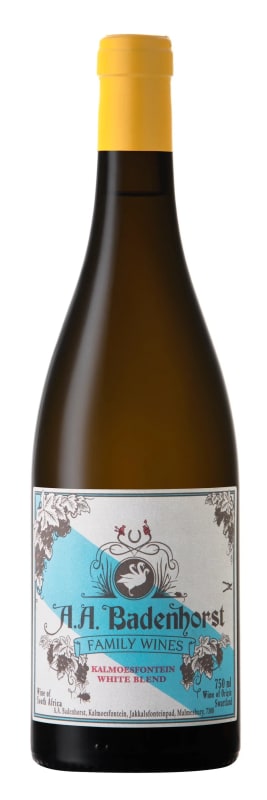


Winemaker Notes
Aromatic layers of citrus flowers, stone fruit, tea, spice and a delicate perfume. Mineral and stone fruit flavors form complex flavors and texture, complemented by gentle tannins and a very lengthy finish.
Blend: 33% Chenin Blanc, 28% Grenache Blanc, 9% Viognier, 5% Palomino, 2% Roussanne, 5% Muscat D’Alexandrie, 15% Verdeho, 1% Sauvignon Blanc; 1% Harslevelu, 1% Marsanne
Professional Ratings
-
Robert Parker's Wine Advocate
The A. A. Badenhorst Family Wines 2023 Swartland Kalmoesfontein White Blend is built on a core of Chenin Blanc supported by Clairette Blanche, Grenache Blanc, Palomino, Viognier, Roussanne, Muscat d’Alexandrie and Verdelho, with additional small components that are not fully disclosed. Aged one year in old wooden vats, followed by a year in tank and made without sulfur additions, the wine moves in a distinctly savory direction. Salty on the finish and beautifully textured, it balances broad richness with sharp focus and precision. There is a tactile sappiness and a subtle crunch on the palate, giving the wine energy and tension. This reinforces the sense that this white has the capacity to age gracefully.
Rating: 95+ -
James Suckling
Lemon rind, beeswax, chamomile, pomelo and sliced melon on the nose of this creamy but bright white. It’s textured and waxy with a medium to full body and excellent freshness. Salty at the end. 33% chenin blanc and 28% grenache blanc, with smaller amounts of eight other white varieties. Drink now or hold.
-
Vinous
The 2023 White Blend Kalmoesfontein is a field blend that spends one year in very old foudres plus ten months in concrete. There is a touch of reduction on the nose, with honeysuckle and jasmine scents and ample white fruit. The palate is well balanced with a fine bead of acidity, waxy in texture, with a bright and edgy, saline finish that urges you back for more. One of the best whites that Adi Badenhorst has made.


Full-bodied and flavorful, white Rhône blends originate from France’s Rhône Valley. Today these blends are also becoming popular in other regions. Typically some combination of Grenache Blanc, Marsanne, Roussanne and Viognier form the basis of a white Rhône blend with varying degrees of flexibility depending on the exact appellation. Somm Secret—In the Northern Rhône, blends of Marsanne and Roussanne are common but the south retains more variety. Marsanne, Roussanne as well as Bourboulenc, Clairette, Picpoul and Ugni Blanc are typical.

With an important wine renaissance in full swing, impressive red and white bargains abound in South Africa. The country has a particularly long and rich history with winemaking, especially considering its status as part of the “New World.” In the mid-17th century, the lusciously sweet dessert wines of Constantia were highly prized by the European aristocracy. Since then, the South African wine industry has experienced some setbacks due to the phylloxera infestation of the late 1800s and political difficulties throughout the following century.
Today, however, South Africa is increasingly responsible for high-demand, high-quality wines—a blessing to put the country back on the international wine map. Wine production is mainly situated around Cape Town, where the climate is generally warm to hot. But the Benguela Current from Antarctica provides brisk ocean breezes necessary for steady ripening of grapes. Similarly, cooler, high-elevation vineyard sites throughout South Africa offer similar, favorable growing conditions.
South Africa’s wine zones are divided into region, then smaller districts and finally wards, but the country’s wine styles are differentiated more by grape variety than by region. Pinotage, a cross between Pinot Noir and Cinsault, is the country’s “signature” grape, responsible for red-fruit-driven, spicy, earthy reds. When Pinotage is blended with other red varieties, like Cabernet Sauvignon, Merlot, Syrah or Pinot Noir (all commonly vinified alone as well), it is often labeled as a “Cape Blend.” Chenin Blanc (locally known as “Steen”) dominates white wine production, with Chardonnay and Sauvignon Blanc following close behind.