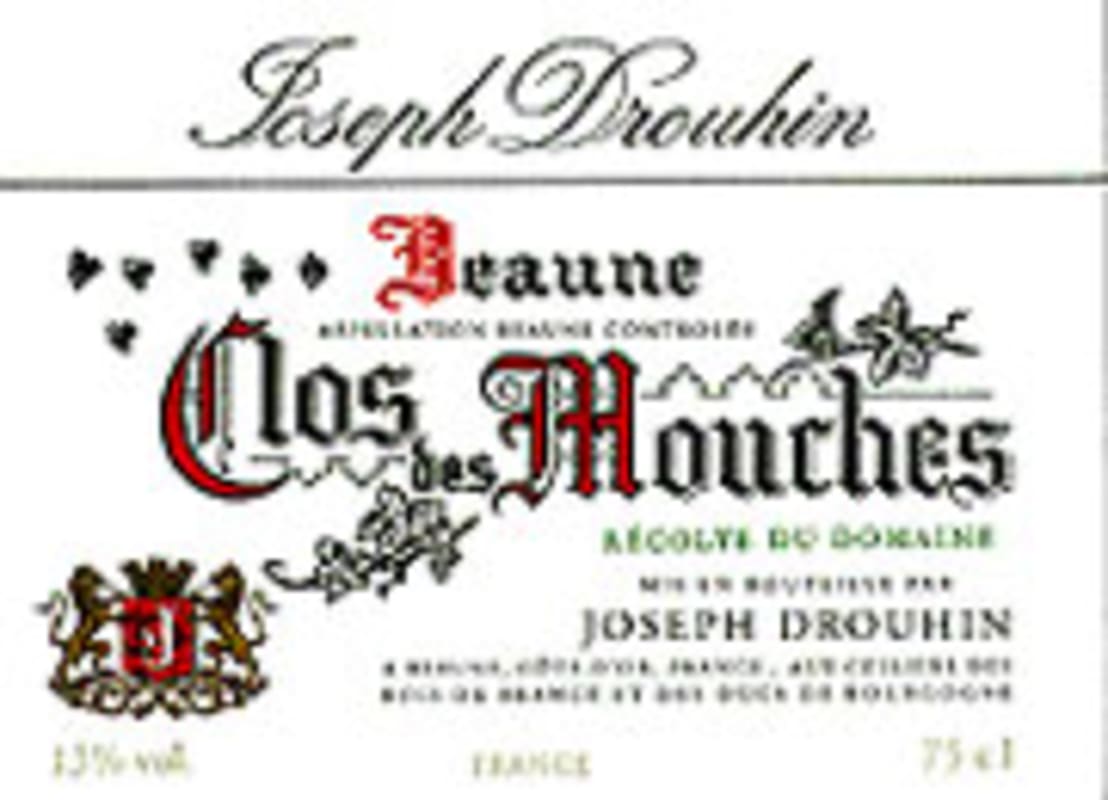

Winemaker Notes
After the destruction of the Burgundy vineyards due to the phylloxera epidemic of 1875-1880, Clos des Mouches was entirely replanted with Pinot Noir. Having fortunately come across some ancient documents which revealed that the vineyard had previously produced an excellent white wine, Maurice Drouhin, in 1921, began replanting with some Chardonnay. The result was of exceptional quality. To-day, there is an almost equal balance between white and red.
The Clos des Mouches red is made from Pinot noir and a small percentage of Pinot Gris ; the vineyard takes full advantage of the sun exposure to the South-East. The hand-picked grapes are brought to the winery in small 50-pound crates. The grapes are then pressed and sometimes the stems are kept. An 18 day-fermentation and maceration takes place with daily pumping over and punching of the cap. The wine is then put in barrels where it matures, smoothes out and looses its acidity. After 15 to 18 months of "élevage" in wood (old and new oak) and frequent tastings, Clos des Mouches is bottled.
It is distinguished by its elegance and finesse : round, velvety, and beautifully balanced. It has complexity and depth in a soft but very intense sort of way. Aromas are very refined with ripe black cherry, spices, earthy and lightly smoked notes with just the right touch of tannin. This wine can be put away 10 years or even 20, depending on the vintage; it can also be enjoyed in its youth, with all its glorious fruitiness.
Professional Ratings


Celebrated as some of the best wine in the universe, red wine from Burgundy, otherwise known as red Burgundy, is Pinot noir. In fact Burgundy is the birthplace of Pinot noir and the source of the planet’s most sensual, delicate, valuable and sought-after Pinot noir wines.
Understanding and enjoying red Burgundy can stay simple, with a basic knowledge of its subregions, become more intricate by dialing down to the villages and vineyards or become a life-long passion, exploring climats (plots of vines), vintages and the post French Revolution land ownership laws. In any case, a fine red Burgundy will display refined nuances of black currant, red fruit, earth, spice, alluring floral aromatics and have great elegance, complexity and longevity.
Most famous, praised and collected of Burgunday are those from the Côte d'Or. Hundreds of millions of years ago, the area now called Côte d'Or was under a warm ocean whose sea floor has, over time, shifted and decomposed into various layers of limestone, sandstone and clay interspersed with ancient fossilized sea creatures. This is what is referred to as the famous escarpment upon which all of the highly sought-after Grands Crus and Premiers Crus vineyards can be found. In other words, from north to south, the best vineyards of Gevrey-Chambertin, Morey-St-Denis, Chambolle-Musigny, Vougeot, Vosne-Romanée, Flagey-Echezeaux, Nuits-St-Georges, Aloxe-Corton, Pommard and Volnay follow the path of this ancient sea bed.