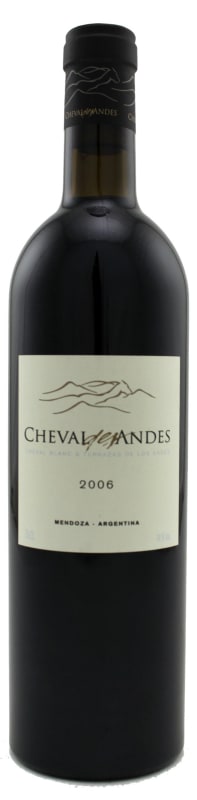


Winemaker Notes
Professional Ratings
-
Robert Parker's Wine Advocate
The 2006 Cheval des Andes was bottled in early 2008 but has not yet been released. The 2006 vintage is superb throughout Mendoza and this wine, as in many other bodegas I visited in April 2008, shows off the extra dimension of complexity made possible in an exceptional year. The wine is composed entirely of Malbec and Cabernet Sauvignon. It is a bit more saturated than the 2005 with a splendid perfume of pain grille, mineral, espresso, black cherry, and black raspberry that leaps from the glass. More opulent and layered than the 2005, it also conceals a bit more structure. The finish seems to go on and on. Drink it from 2015 to 2035.
-
Wine Enthusiast
Dense and dark, with aromas of rubber and leather. Complex and stylish, but with raw power, and the flavors of blackberry, fig paste and herbs register as modern Mendoza. Malbec-Cabernet Sauvignon-Petit Verdot; best from 2011-2015
-
Wine & Spirits
From the joint venture between Cheval Blanc of St-Emilion and Terrazas de los Andes, this 2006 is still youthful, full of vitality and force. The tannins are wild, almost unruly, corralled by ripe flavors with the kind of depth that will reward cellaring. Give it three or four years, then open it with a ribeye.
-
Wine Spectator
This broad-shouldered red delivers a mix of dark currant, licorice, damson plum and blackberry fruit flavors, well-integrated with espresso-tinged toast. Stays dense and loamy through the finish. Malbec, Cabernet Sauvignon and Petit Verdot. Drink now through 2011


One of the world’s most classic and popular styles of red wine, Bordeaux-inspired blends have spread from their homeland in France to nearly every corner of the New World. Typically based on either Cabernet Sauvignon or Merlot and supported by Cabernet Franc, Malbec and Petit Verdot, the best of these are densely hued, fragrant, full of fruit and boast a structure that begs for cellar time. Somm Secret—Blends from Bordeaux are generally earthier compared to those from the New World, which tend to be fruit-dominant.

With vineyards tretching along the eastern side of the Andes Mountains from Patagonia in the south to Salta in the north, Argentina is one of the world’s largest and most dynamic wine producing countries—and most important in South America.
Since the late 20th century vineyard investments, improved winery technology and a commitment to innovation have all contributed to the country’s burgeoning image as a producer of great wines at all price points. The climate here is diverse but generally continental and agreeable, with hot, dry summers and cold snowy winters—a positive, as snow melt from the Andes Mountains is used heavily to irrigate vineyards. Grapes very rarely have any difficulty achieving full ripeness.
Argentina’s famous Mendoza region, responsible for more than 70% of Argentina’s wine production, is further divided into several sub-regions, with Luján de Cuyo and the Uco Valley most noteworthy. Red wines dominate here, especially Malbec, the country’s star variety, while Chardonnay is the most successful white.
The province of San Juan is best known for blends of Bonarda and Syrah. Torrontés is a specialty of the La Rioja and Salta regions, the latter of which is also responsible for excellent Malbecs grown at very high elevation.